
Newswire
Rome: In the rolling hills of western Sicily, where a devastating earthquake once reduced entire communities to rubble, the town of Gibellina has emerged as one of Italy’s most remarkable examples of cultural regeneration. Designated Italy’s first Capital of Contemporary Art for 2026, the town is redefining how art can preserve memory, heal collective trauma and breathe new life into communities scarred by disaster.
The story of Gibellina is inseparable from the catastrophic Belìce Valley earthquake of 1968, which claimed more than 300 lives, displaced tens of thousands of people and destroyed several historic towns, including the original settlement of Gibellina. Rather than rebuilding on the ruins, authorities established a new town six miles away, envisioning a community where architecture and contemporary art would become symbols of resilience and renewal.
Today, that ambitious vision has evolved into one of Italy’s largest open-air collections of modern art, with more than 5,000 artworks spread across a town of just 3,600 residents.
Among the artists contributing to the town’s cultural revival is Sicilian contemporary artist Rossana Taormina, whose latest installation explores the fragility of memory through a series of fading neon signs spelling the Italian word memoria. Displayed at the Belìce Epicentro della Memoria Viva museum, the work reflects both personal and collective remembrance.
Born four years after the earthquake, Taormina spent her early childhood in temporary shelters before settling in the rebuilt town. Having lost many family photographs in the disaster, she says her imagination was shaped by fragments of memory and the ruins surrounding her childhood.
“Memory and landscape have always been central to my work,” she says, describing how the valley continues to influence her artistic identity despite now living in Palermo.
The museum documents the human impact of the earthquake while showcasing how contemporary artists continue to reinterpret the region’s past through innovative installations.
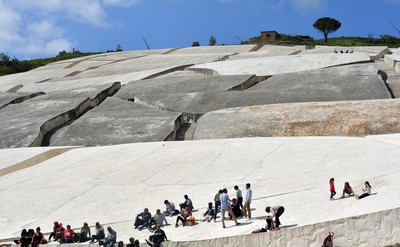
Perhaps the valley’s most internationally recognised landmark is the Cretto di Burri, created by renowned Italian sculptor Alberto Burri. Rather than reconstructing the destroyed village of Gibellina Vecchia, Burri covered its ruins with enormous slabs of white concrete, preserving the original street layout beneath a monumental land-art installation.
From above, the vast geometric structure resembles a cracked white blanket draped across the Sicilian countryside. Visitors walk through narrow pathways following the exact routes of the former streets, transforming remembrance into a physical experience.
The project was championed by the late mayor Ludovico Corrao, whose vision extended beyond reconstruction. Convinced that beauty could restore hope after tragedy, he invited many of Italy’s leading architects, sculptors and artists during the 1970s and 1980s to redesign the new town.
His daughter, Antonella Corrao, now co-president of the Fondazione Orestiadi, says art became the community’s answer to suffering.
“There had been too much pain and destruction,” she explains. “Only art could save the soul of Gibellina.”
The rebuilt town reflects that philosophy. Giant sculptures line its streets, striking modern buildings punctuate the skyline and expansive public squares replace conventional urban planning. Visitors encounter monumental stars, sculptural monuments, abstract murals and bold architectural experiments that blur the boundary between public space and artistic expression.
The Capital of Contemporary Art programme has accelerated this transformation by opening previously inaccessible cultural venues to the public.
One highlight is the long-unfinished Teatro di Consagra, originally designed by sculptor Pietro Consagra. Left incomplete for decades, the dramatic wave-shaped concrete structure has now been repurposed as an exhibition venue, hosting multimedia installations by internationally acclaimed artists.
Artistic director Andrea Cusumano believes Gibellina should not simply be viewed as an outdoor museum but as a living community where art becomes part of everyday life.
While many public spaces remain underused, organisers hope this year’s exhibitions, performances and artist residencies will encourage residents to reclaim the town’s unique architectural landscape.
The regeneration of the wider Belìce Valley is also gathering pace. Nearby Poggioreale Vecchia, another town abandoned after the earthquake, is preparing to reopen sections of its historic centre following extensive restoration work. Among its first attractions will be a multimedia museum housed in a restored aristocratic residence, where recovered photographs have been transformed into immersive digital exhibitions recounting everyday life before the disaster.
Local authorities believe cultural tourism can become a catalyst for broader economic revival, creating employment opportunities and encouraging younger generations to remain in the region.
Nearly six decades after the earthquake reshaped western Sicily, Gibellina stands as a powerful example of how art, memory and community can coexist. More than a monument to tragedy, the town has become a living laboratory of creativity, demonstrating that cultural investment can preserve history while offering hope for the future.