
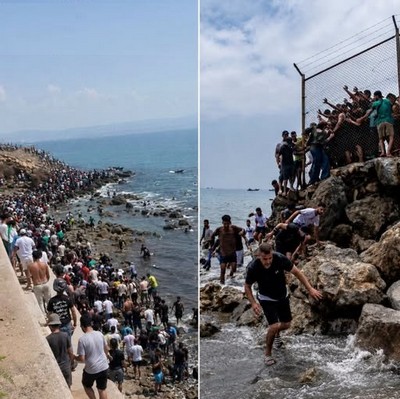
Brussels: The European Union this week called for a coordinated response to border security following the mass arrival of tens of thousands of migrants into Spain’s North African enclave of Ceuta, with European Commission President Ursula von der Leyen describing the protection of the bloc’s external frontiers as a “shared European responsibility.”
The appeal came as Spain continued efforts to return thousands of migrants who entered Ceuta after swimming or crossing around border controls from neighbouring Morocco, triggering renewed debate over migration management, border security and European solidarity.
In a letter to Spanish Prime Minister Pedro Sánchez, von der Leyen praised Spain’s handling of the crisis and urged greater cooperation among EU member states to strengthen border protection at vulnerable entry points.
“The protection of all our external borders is a shared European responsibility,” she said, calling for united action, enhanced surveillance and, where necessary, the use of physical barriers to safeguard the EU’s external frontiers.
The Commission president also indicated that the European Union was prepared to deepen cooperation with Morocco, describing Rabat as a strategic partner in combating migrant smuggling and irregular migration. She suggested that Brussels could expand technical, financial and operational assistance to Morocco, particularly in relation to the Spanish enclaves of Ceuta and Melilla, including improved border management systems and early-warning mechanisms.
The latest migration surge prompted an emergency video conference of EU interior ministers to discuss immediate policy responses and broader measures to prevent similar incidents in the future.
Although the overwhelming majority of the estimated 50,000 people who entered Ceuta have already been returned to Morocco, Spanish authorities said several thousand migrants remain in the enclave while processing continues. Officials have also reinforced border infrastructure, including the installation of an additional security barrier near one of the principal crossing points.
The incident has exposed divisions within the European Union over migration policy. Several member states adopted temporary border controls following the crossings, while some governments argued for tougher restrictions within the Schengen free-travel area. Spain criticised what it described as a lack of solidarity from certain European partners and called for coordinated discussions rather than unilateral measures.
Migration analysts argue that the Ceuta crossings were driven less by structural migration pressures than by misinformation circulating online, including false claims that Spain had opened its borders. The rapid spread of such rumours is believed to have encouraged thousands of mostly young Moroccan men to attempt the dangerous crossing within a short period.
Experts note that the situation differs significantly from the 2015 European migration crisis, which was largely driven by conflicts such as the Syrian civil war and involved substantial numbers of asylum seekers. Instead, the recent events are viewed as an isolated but politically sensitive episode that nevertheless reignited concerns about border security across Europe.
The crisis has also renewed debate over the EU’s recently adopted migration framework, which allows failed asylum seekers to be transferred to designated safe third countries, known as “return hubs.” While the legal framework has been approved, no such agreements have yet been implemented.
Von der Leyen said discussions among interior ministers would mark only the first stage of the EU’s response, with migration and external border management expected to feature prominently at the European Council summit scheduled for October.
The developments underscore the continuing challenge facing the European Union as it seeks to balance humanitarian obligations with effective border management while maintaining unity among member states on one of the bloc’s most contentious policy issues.