
Liaquat Ali
Islamabad: Pakistan and the United States this week reaffirmed their commitment to expanding bilateral cooperation in education, research and emerging technologies, with both sides placing particular emphasis on strengthening collaboration in cybersecurity education and capacity building.
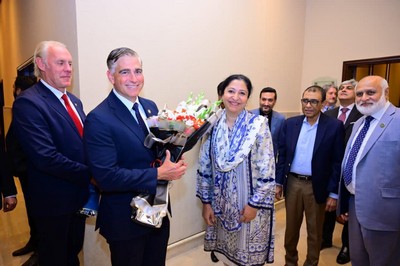
The understanding was reached during a meeting between Federal Minister for Education and Professional Training Dr Khalid Maqbool Siddiqui and a visiting United States Congressional delegation comprising Congressman Michael James Baumgartner, Representative for Washington’s 5th Congressional District, and Congressman Ryan Keith Zinke, Representative for Montana’s 1st Congressional District and former U.S. Secretary of the Interior.
The meeting was attended by Minister of State for Federal Education and Professional Training Wajiha Qamar, National Vocational and Technical Training Commission (NAVTTC) Chairman Qamar-ul-Islam Raja, the ministry’s secretary and senior officials.
During the discussions, Dr Siddiqui stressed the need to develop specialised cybersecurity courses and internationally recognised certification programmes to equip students and professionals with the skills required to address evolving digital security challenges.
Both sides also explored opportunities to promote partnerships between Pakistani and American universities and educational institutions in curriculum development, faculty collaboration, joint research and knowledge sharing in cybersecurity and other emerging technologies.
Welcoming the visiting delegation, the federal minister expressed confidence that the visit would further strengthen the longstanding relationship between Pakistan and the United States. He reaffirmed that ties with the United States remain an important pillar of Pakistan’s foreign policy and noted that bilateral relations continue to advance on a positive trajectory.
The two sides underscored the importance of sustained high-level engagement to deepen cooperation across a wide range of sectors, including trade, investment, energy, minerals, health, education and agriculture.
Dr Siddiqui also welcomed the resumption of United States Congressional delegation visits to Pakistan and expressed hope that such exchanges would become a regular feature of bilateral engagement.
Highlighting the role of education as a cornerstone of bilateral relations, the minister appreciated the continued success of the Fulbright Programme and other United States-sponsored academic exchange initiatives, describing them as merit-based opportunities that have enabled thousands of Pakistani students and scholars to pursue higher education and research.
He encouraged greater participation from all provinces and across diverse academic disciplines, particularly in energy, water, agriculture, health, education and climate-related studies.
The meeting noted that more than 44,000 Pakistanis have benefited from United States Government-sponsored exchange programmes, reflecting the strong people-to-people ties between the two countries.
The minister reaffirmed Pakistan’s commitment to expanding academic collaboration through stronger partnerships between universities and research institutions.
Both sides discussed the establishment of joint research centres, dual-degree programmes, faculty exchange initiatives and collaborative projects in public health, climate resilience, water management, food security and teacher education, while respecting the legal and regulatory frameworks of both countries.
The discussions also focused on strengthening cooperation in science, technology and innovation to address shared development challenges and promote sustainable growth.
Recognising the growing importance of critical technologies, Dr Siddiqui noted that United States universities and industries continue to value international talent in science, technology, engineering and mathematics (STEM). He reiterated Pakistan’s readiness to serve as a reliable partner in information technology and innovation by encouraging collaboration between Pakistani technology companies, universities and their American counterparts in information technology, financial technology and agricultural technology.
The meeting further explored opportunities for targeted academic mobility programmes, short-term research exchanges, virtual laboratories and joint innovation incubators aimed at promoting research, entrepreneurship and skills development.
Both sides agreed that education, scholarships and innovation remain among the most effective avenues for strengthening bilateral relations and fostering mutual understanding.
The Ministry of Federal Education and Professional Training reaffirmed its commitment to expanding educational cooperation with the United States, expressing confidence that sustained collaboration in education, research, innovation and emerging technologies would further reinforce the longstanding partnership between the two countries.