

Newswire
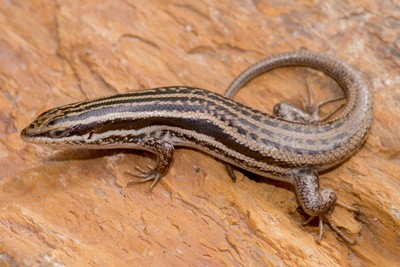
Peshawar: An international team of researchers from Pakistan, Germany and Slovakia this week identified a rare grass skink in Khyber Pakhtunkhwa’s Lower Dir district, solving a decades-old scientific mystery surrounding a reptile previously known from only a single specimen collected in Afghanistan more than 50 years ago.
The discovery was made during field surveys in the rain-soaked foothills of Lower Dir by a team that included Dr Rafaqat Masroor, Curator at the Pakistan Museum of Natural History, alongside researchers from Comenius University in Slovakia and scientific institutions in Germany.
According to a study that has been accepted for publication and is currently in the production stage, the skink populations found in eastern Afghanistan and Pakistan’s Lower Dir represent a distinct species within the genus Heremites. The researchers have proposed the scientific name Heremites afghanicus, with “Afghan grass skink” or “Dir grass skink” suggested as its common English name.
The species traces its scientific history back to 1972, when researcher Clas Naumann collected a small striped lizard in eastern Afghanistan. The preserved specimen remained the only known example of the reptile for more than five decades, leaving scientists uncertain whether it represented an isolated individual, a misidentified species or an evolutionary relic.
The newly discovered population in Lower Dir has now provided the evidence needed to resolve the mystery.
Although the skinks closely resemble populations found farther west, particularly in Iran, detailed genetic and morphological analyses revealed that they represent a separate evolutionary lineage.
Lead researchers Dr Daniel Jablonski of Comenius University and Dr Rafaqat Masroor said the lizards had effectively remained hidden in plain sight because of their striking physical resemblance to Iranian populations.
Using advanced multi-locus DNA sequencing, the research team found substantial genetic differences between the newly identified species and its closest relatives. Mitochondrial DNA comparisons revealed divergence rates ranging from 15.8 to 21 per cent, confirming that the population is genetically distinct.
The study indicates that Heremites afghanicus diverged from its western relatives during the Late Miocene epoch, evolving independently for millions of years in the rocky valleys and mountainous landscapes where the Palearctic and Oriental biogeographical regions meet.
Researchers said the discovery highlights the enduring importance of museum collections in modern scientific research. The specimen preserved for more than half a century provided the historical link needed to connect the Afghan record with the newly documented population in Pakistan.
By combining museum records, extensive field surveys and molecular genetic analysis, scientists concluded that the reptile is not merely an isolated population but a previously unrecognised species with its own unique evolutionary history.
The researchers noted that because the species’ natural habitat extends across Lower Dir in Pakistan and Nangarhar Province in Afghanistan, its long-term conservation will require cross-border ecological cooperation, coordinated scientific research and habitat protection to safeguard the newly recognised species.