
France elevates ties with Malaysia to strategic partnership, secures rare earths cooperation
Newswire
Kuala Lumpur: France and Malaysia have upgraded their bilateral relations to a strategic partnership, opening a new chapter in cooperation on critical minerals, defence, advanced technology, energy and regional connectivity, with Kuala Lumpur agreeing to ease restrictions on exports of raw rare earth materials to support joint industrial development.
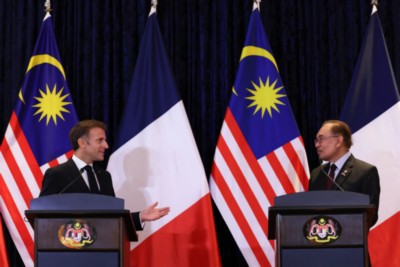
The announcement followed talks between French President Emmanuel Macron and Malaysian Prime Minister Anwar Ibrahim in Kuala Lumpur this week, during which the two leaders outlined an expanded framework for cooperation aimed at strengthening economic and strategic ties.
The agreement on rare earths represents a significant development in France’s efforts to secure alternative sources of critical minerals and reduce its dependence on China, which dominates global rare earth production and processing.
Under the understanding, Malaysia will allow certain exports of raw rare earth materials to France following a commitment by Paris to cooperate in developing the country’s domestic processing and refining capabilities.
Macron said the upgraded partnership would help both countries strengthen their strategic independence while expanding cooperation in defence and security.
“This renewed partnership will contribute to strengthen our independence on both sides,” he said at a joint news conference with Anwar.
The rare earths cooperation is expected to be supported by a joint venture between French company Carester and Malaysian mining firm Malaco, which are working on a mining and refining project, including a separation facility in Malaysia’s Perak state.
The proposed plant is designed to process an estimated 13,000 metric tonnes of rare earth materials annually and is expected to begin operations next year.
Malaysia had imposed a ban on raw rare earth exports in 2024 to protect its domestic mineral resources and encourage local processing. However, it eased the restrictions last month, permitting conditional shipments for research and processing purposes as part of efforts to develop a domestic refining industry.
Macron highlighted the Carester-Malaco venture during a business forum later in the day, explaining that the project would enable France to secure supplies of important industrial components through a combination of mining, processing and refining activities in Malaysia and France.
The two countries also exchanged a memorandum of understanding on critical minerals, providing a framework for developing an integrated, higher-value mineral industry through research, technological development and industrial cooperation.
Beyond minerals, the strategic partnership encompasses several areas of advanced technology and infrastructure.
Among the agreements announced was cooperation between Malaysia’s SkyeChip and French chip designer SiPearl on chiplet development, reflecting growing interest in strengthening collaboration in semiconductor technologies.
Another agreement involves Telekom Malaysia and France’s Alcatel Submarine Networks on a submarine cable project intended to enhance Malaysia’s digital connectivity and strengthen its telecommunications infrastructure.
Energy cooperation also featured prominently in the discussions, with Anwar seeking French government and industrial support for the ASEAN Power Grid initiative, a regional project designed to connect electricity networks across Southeast Asian countries.
France also expressed readiness to cooperate with Malaysia in developing its nuclear power capabilities and facilitating access to European liquefied natural gas markets.
Defence and regional security formed another important pillar of the upgraded relationship.
Macron announced plans for the two countries to establish a regional centre to counter hybrid threats, including cyberattacks and disinformation campaigns. French aerospace giant Airbus has also agreed to supply helicopters to the Malaysian air force, although further details of the arrangement were not disclosed.
France is also interested in pursuing additional defence agreements involving submarines and fighter aircraft, signalling its intention to expand its role as a defence and security partner in Southeast Asia.
The discussions come as Malaysia reviews the reliability of international defence suppliers following Norway’s decision to revoke an export licence for missiles intended for the Malaysian naval fleet. The episode has raised questions in Kuala Lumpur about the dependability of foreign defence supply arrangements.
Macron’s visit, his first to Malaysia since 2017, comes ahead of the 70th anniversary of diplomatic relations between the two countries next year. The two-day trip reflects France’s broader effort to deepen its economic and strategic engagement across the Indo-Pacific region.
While no financial details of the announced agreements were disclosed, the range of initiatives demonstrates the expanding scope of French-Malaysian cooperation, from mineral security and semiconductor development to defence, energy and digital infrastructure.
The strategic partnership also reflects a shared interest in building more resilient industrial supply chains, strengthening technological capabilities and diversifying international economic partnerships at a time when access to critical minerals and advanced technologies has become increasingly important to global economic and national security.
For France, closer engagement with Malaysia offers an opportunity to strengthen its presence in Southeast Asia while securing access to resources essential for its industrial and energy ambitions. For Malaysia, cooperation with French companies provides avenues for developing domestic processing capacity, attracting technology and investment, and moving towards higher-value industrial production.