
Celina Ali
Islamabad: Pakistan’s assumption of the Shanghai Cooperation Organisation’s chairmanship for 2026-27 has opened a significant new window for Islamabad to advance its connectivity agenda, with Kazakhstan emerging as one of the most promising Central Asian partners in Pakistan’s drive to link Eurasian markets with the Arabian Sea.
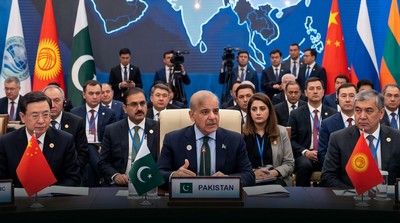
The SCO summit held in Bishkek on August 31 and September 1 marked the organisation’s 25th anniversary and came at a moment when trade routes, energy networks, technology and regional security are undergoing profound change.
The summit brought together the leaders of the SCO member states, including Pakistan and Kazakhstan, and reaffirmed cooperation in security, trade, investment, technology, energy and sustainable development. More than 20 additional documents were adopted at the meeting, reflecting the organisation’s increasingly broad economic and strategic agenda.
For Islamabad, however, the most consequential outcome was the transfer of the SCO chairmanship to Pakistan and the decision to host the next meeting of the Council of Heads of State in 2027.
Pakistan has chosen the theme “Turning Vision into Action: Connectivity, Innovation and Shared Prosperity” for its chairmanship — a theme that fits particularly well with the country’s ambitions for deeper engagement with Central Asia.
Among the SCO’s Central Asian members, Kazakhstan holds special importance.
Kazakhstan is Central Asia’s largest economy and one of the region’s most strategically positioned states. Rich in energy resources, minerals and agricultural commodities, it has also invested heavily in developing transport corridors linking China, Central Asia, the Caspian region and European markets.
Its geographical position gives Kazakhstan a pivotal role in the emerging Eurasian transport architecture.
For Pakistan, that geography presents an attractive opportunity.
Pakistan provides access to the Arabian Sea through its ports, while Kazakhstan offers a gateway into the wider Central Asian and Eurasian market. The two countries therefore have complementary economic interests: Kazakhstan needs reliable access to southern markets and maritime routes, while Pakistan is seeking stronger commercial links with the resource-rich and rapidly developing Central Asian economies.
The relationship is already moving in that direction.
During Kazakh President Kassym-Jomart Tokayev’s state visit to Pakistan on February 4, 2026, the two countries agreed to work towards increasing bilateral trade to $1 billion within two years, while identifying trade, investment, defence, people-to-people contacts and connectivity as priority areas.
The target is ambitious, particularly when compared with the current level of trade, but it reflects a growing political recognition in both capitals that the bilateral relationship has considerable untapped potential.
The challenge is no longer whether Pakistan and Kazakhstan want closer economic ties. Both sides have repeatedly expressed that ambition.
The harder question is how to make trade between the two geographically distant countries commercially predictable.
Pakistan’s exports to Kazakhstan were estimated at around $250.7 million in FY2024-25, while imports were around $1.12 million according to Pakistan’s Foreign Ministry. Kazakh figures for January-November 2025 put overall bilateral trade at $105.6 million, more than twice the comparable figure for 2024.
The differing figures reflect different reporting periods and methodologies, but they point to the same underlying reality: bilateral commerce remains significantly below its potential.
Connectivity is the missing link.
Kazakhstan is landlocked, while Pakistan possesses direct access to the Arabian Sea. Theoretically, this creates a powerful economic complementarity. In practice, moving goods across multiple borders remains difficult, with Afghanistan representing both an essential transit geography and a major challenge.
That is why road, rail, air and maritime connectivity have increasingly featured in Pakistan-Kazakhstan discussions.
Among the proposals under consideration is the concept of a Kazakhstan-Turkmenistan-Afghanistan-Pakistan railway link, which could eventually create a more direct transport connection between Central Asia and Pakistani ports.
Kazakhstan’s wider connectivity role
Kazakhstan’s importance extends beyond its bilateral relationship with Pakistan.
The country has become an increasingly significant participant in the development of alternative Eurasian transport routes, linking China with Central Asia, the Caspian Sea and onward markets.
For Pakistan, closer engagement with Astana could therefore provide access not only to the Kazakh market but also to wider Central Asian commercial networks.
This makes Kazakhstan a particularly valuable partner as Pakistan prepares to use its SCO chairmanship to promote practical connectivity.
The SCO itself cannot build railways or ports. Nor is it an economic union comparable to the European Union.
Its value lies in bringing together countries that otherwise have different political systems, economic interests and strategic priorities, allowing them to develop common approaches to regional challenges.
Pakistan can use that platform to turn broad declarations on connectivity into concrete initiatives.
No serious discussion of Pakistan-Central Asia connectivity, however, can ignore Afghanistan.
A land route connecting Kazakhstan with Pakistani ports would have to pass through Afghanistan or depend on longer multimodal alternatives. The security and political environment in Afghanistan therefore has a direct bearing on the commercial viability of any north-south corridor.
This is where the SCO’s security agenda becomes relevant.
The Bishkek summit placed considerable emphasis on terrorism, extremism, transnational crime and regional security, while the organisation also approved provisions relating to a new Universal Centre for Countering Challenges and Threats to the Security of SCO Member States.
For Pakistan and Kazakhstan, security and economic connectivity are closely linked.
A railway corridor can only succeed if cargo can travel safely. A trade route can only become commercially attractive if border crossings operate efficiently. And investors will remain cautious unless they can rely on predictable movement of goods, capital and people.
Pakistan’s SCO chairmanship provides Islamabad with an opportunity to place these practical issues at the heart of the organisation’s economic agenda.
One priority could be greater coordination among member states on customs and transit procedures. Better infrastructure alone will not generate trade if cargo continues to face delays at borders.
Pakistan could also encourage greater use of existing regional transport corridors while longer-term infrastructure projects are developed.
For Kazakhstan and Pakistan specifically, establishing more regular freight and passenger links could gradually create the commercial confidence needed to expand bilateral trade.
Investment in logistics, warehousing, railways, ports and digital trade infrastructure could further strengthen the emerging north-south connectivity chain.
There is also scope for greater coordination between SCO initiatives and other regional connectivity mechanisms, particularly those linking Central Asia with the Caspian region, China and South Asia.
Pakistan and Kazakhstan established diplomatic relations in 1992, and Islamabad was among the first countries to recognise Kazakhstan following its independence.
The relationship has remained cordial for decades, but its economic dimension has historically been modest.
President Tokayev’s February visit to Pakistan, the ambitious $1 billion bilateral trade target and the growing emphasis on connectivity indicate that both countries increasingly see their relationship through a broader economic and strategic lens.
Kazakhstan’s growing role in Eurasian transport networks makes it particularly well placed to become an important partner in Pakistan’s Central Asia strategy.
For Islamabad, the opportunity is to use the SCO chairmanship not merely to host meetings and issue declarations, but to build practical bridges between Central Asian economies and the Arabian Sea.
And in that effort, Kazakhstan could prove to be one of Pakistan’s most important partners — a resource-rich, economically significant and strategically positioned country capable of helping transform the idea of Eurasian connectivity into a functioning commercial reality.