
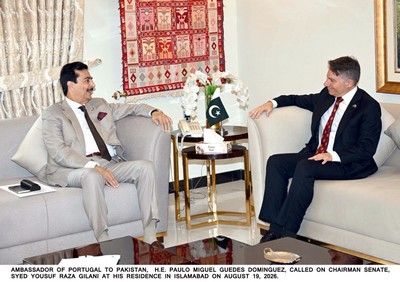
Islamabad: Pakistan and Portugal have reaffirmed their commitment to deepening longstanding friendly ties, with a particular focus on expanding trade, investment, labour mobility, education and parliamentary cooperation, as Portuguese Ambassador Paulo Miguel Guedes Dominguez held talks with Senate Chairman Syed Yousaf Raza Gilani in Islamabad.
The meeting, held at the Senate chairman’s residence in Ministers’ Enclave this week, carried a strong economic dimension, with both sides exploring avenues to translate the cordial political relationship between the two countries into broader commercial and institutional partnerships.
The Portuguese envoy’s engagement with the Senate leadership comes at a time when Pakistan is seeking to diversify its economic partnerships and attract greater foreign investment, while Portugal is emerging as an increasingly relevant European partner for cooperation in trade, human resource development, education, technology and maritime-related sectors.
During the meeting, Ambassador Dominguez conveyed Portugal’s keen interest in further strengthening bilateral relations, particularly in trade, investment and economic cooperation. His emphasis on expanding commercial engagement reflected Lisbon’s interest in exploring new opportunities with Pakistan and encouraging stronger links between the two business communities.
Senate Chairman Gilani said Pakistan attached great importance to its longstanding and friendly relations with Portugal and expressed the country’s desire to take bilateral cooperation to a broader and more productive level.
He identified trade and investment, agriculture, information technology, education, culture and the blue economy as areas offering considerable potential for closer cooperation.
Gilani stressed that the existing level of bilateral trade did not fully reflect the potential of the two economies and called for the identification of new avenues that could help businesses from both countries establish stronger commercial links.
He invited Portuguese companies and investors to explore Pakistan’s emerging economic and business opportunities, saying greater private-sector engagement could create mutually beneficial partnerships and contribute to strengthening bilateral economic relations.
For Pakistan, such cooperation carries particular importance as Islamabad continues efforts to attract foreign investment, expand exports and establish deeper links with European markets. Portugal, with its position within the European Union and its experience in sectors ranging from maritime activities and renewable energy to technology, tourism and manufacturing, offers opportunities for Pakistani businesses seeking greater access to European networks.
Ambassador Paulo Miguel Guedes Dominguez’s participation in the dialogue underscored Portugal’s interest in giving greater substance to bilateral ties.
The envoy thanked Gilani for the warm welcome and expressed Portugal’s desire to strengthen relations with Pakistan, particularly in the economic sphere.
His engagement with the Senate leadership also provided an opportunity to discuss how parliamentary diplomacy could complement government-to-government and business-to-business contacts.
Both sides agreed on the importance of sustained engagement and regular exchanges to build greater understanding and identify new areas of cooperation.
The ambassador’s emphasis on trade and investment comes against the backdrop of a broader effort by Pakistan to attract European investors and promote itself as a market with a large consumer base, a young population, growing digital capabilities and expanding opportunities in emerging sectors.
Gilani also highlighted the role of parliamentary diplomacy in strengthening relations between countries.
Referring to the Inter-Parliamentary Speakers’ Conference, he described it as an important platform for promoting peace, security and development in the region.
He stressed the importance of parliamentary engagement as a complementary channel of diplomacy, particularly at a time when global and regional challenges require greater dialogue and cooperation among political institutions.
Closer interaction between the parliaments of Pakistan and Portugal, he suggested, could help strengthen bilateral understanding and provide a platform for legislators to exchange experiences on governance, legislation, economic development and social policy.
The parliamentary dimension could also support greater institutional cooperation between the two countries beyond traditional diplomatic channels.
One of the most significant aspects of the discussions was the role of the Pakistani community in Portugal.
Gilani appreciated the contribution of the Pakistani diaspora, noting that around 50,000 Pakistanis were living and working in Portugal.
He described the community as an important human bridge between the two countries and stressed the need to further strengthen cooperation in labour and human resource development.
The Pakistani community has the potential to play a larger role in promoting bilateral economic relations, particularly by facilitating business contacts, investment flows, cultural exchanges and people-to-people links.
Gilani expressed hope for the early conclusion of the Agreement on Labour Mobility Partnership, describing it as an important framework for expanding cooperation in the labour and human resource sectors.
The agreement, once concluded, could provide greater institutional structure to labour mobility between the two countries and potentially create additional opportunities for Pakistani workers while strengthening Portugal’s access to skilled human resources.
For Islamabad, labour mobility is also an important component of its broader economic relationship with European countries, given the significant role overseas Pakistanis play in supporting their families and contributing to the national economy.
Education emerged as another promising area of bilateral cooperation.
Gilani called for enhanced interaction between Pakistani and Portuguese universities through student and faculty exchange programmes as well as joint research initiatives.
He argued that stronger academic links could create long-term institutional relationships and expose students and researchers from both countries to new ideas, technologies and areas of expertise.
Joint research could also provide opportunities for cooperation in emerging fields such as information technology, artificial intelligence, climate change, agriculture, renewable energy, maritime sciences and other areas connected with the blue economy.
For Pakistan, stronger links with Portuguese universities could provide another channel for expanding its international academic partnerships, while Portuguese institutions could benefit from cooperation with Pakistan’s expanding higher education and research ecosystem.
The Senate chairman also appreciated Portugal’s continued support for Pakistan’s GSP Plus status, which provides preferential access for eligible Pakistani exports to the European Union market.
Gilani expressed hope that continued high-level exchanges and regular bilateral consultations would further consolidate relations between Islamabad and Lisbon.
The GSP Plus arrangement remains particularly important for Pakistan because the European Union is one of the country’s major export destinations.
Portuguese support within the European framework can therefore carry significance beyond bilateral trade, particularly as Pakistan seeks to retain preferential market access and expand the range and value of its exports to European markets.
Greater awareness among Portuguese businesses of Pakistan’s export potential could also help strengthen commercial links and encourage investment partnerships.
The sectors identified during the meeting point towards a potentially broader economic agenda between Pakistan and Portugal.
Agriculture remains an important area for Pakistan, while Portugal’s experience in modern agricultural practices, food processing, technology and value-added production could offer opportunities for cooperation.
Information technology represents another promising field. Pakistan’s expanding pool of IT professionals, software developers, freelancers and technology entrepreneurs provides a potential foundation for greater collaboration with European technology companies.
The blue economy could offer an additional avenue for partnership.
With Pakistan seeking to better utilise its maritime resources and strengthen its coastal economy, cooperation with Portugal — a country with a long maritime tradition — could extend into areas such as fisheries, marine research, shipping, port development, ocean technology, coastal tourism and sustainable management of marine resources.
Such sectoral cooperation could move the bilateral relationship beyond conventional diplomatic exchanges and into areas capable of generating tangible economic outcomes.
The meeting between Gilani and Ambassador Dominguez reflects an effort to build on the friendly political relationship between Pakistan and Portugal by developing stronger economic and institutional foundations.
Both countries have maintained cordial relations for decades, but officials on both sides now appear keen to explore ways of giving the relationship greater economic depth.
The Portuguese ambassador’s engagement with the Senate leadership is particularly relevant in this context because parliamentary diplomacy can help sustain political momentum while creating opportunities for institutional and commercial exchanges.
For Pakistan, stronger ties with Portugal could contribute to its broader engagement with the European Union and help Pakistani businesses develop additional connections within European markets.
For Portugal, Pakistan offers a sizeable market, a young workforce, growing technological capabilities and investment opportunities across multiple sectors.
The challenge, however, will be to convert the goodwill expressed at the political level into sustained business-to-business engagement, increased investment flows, stronger trade links and practical cooperation in education and labour mobility.
The latest meeting provides a platform for that process.
Ambassador Dominguez’s expression of Portugal’s keen interest in strengthening trade, investment and economic cooperation, coupled with Gilani’s invitation to Portuguese companies to explore Pakistan’s emerging opportunities, signals a shared willingness to move towards a more substantive economic partnership.
As both sides reaffirmed their commitment to closer engagement, the focus is now likely to shift towards identifying specific projects and mechanisms through which the two countries can translate their political goodwill into measurable economic and people-to-people dividends.
For Islamabad and Lisbon, the message from Wednesday’s meeting was clear: the foundation of friendship is already in place; the next step is to turn that goodwill into investment, trade, knowledge and opportunities for the people of both countries.