

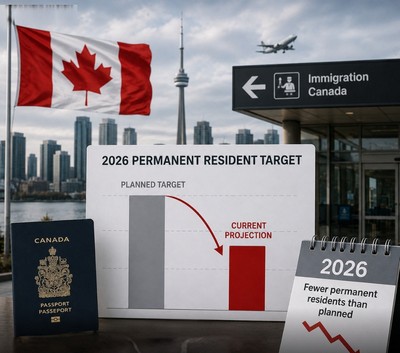
Ottawa: Canada appears to be on course to admit fewer permanent residents than planned in 2026, with newly released federal data showing that immigration levels remained below the pace required to meet the government’s annual target during the first half of the year.
According to data released by Immigration, Refugees and Citizenship Canada (IRCC) on August 18, the country admitted 155,800 new permanent residents between January 1 and June 30, 2026.
The figure is 34,200 below the 190,000 admissions that would have been expected by the middle of the year if Canada were progressing evenly towards its annual target of 380,000 permanent residents.
To reach the halfway mark of its 2026 target, Canada would therefore need to admit 224,200 additional permanent residents during the second half of the year.
The figures point to a slower-than-planned pace of permanent resident admissions, although the final outcome will depend on the pace of processing and admissions during the remaining months of the year.
The economic category accounts for the largest share of Canada’s permanent resident admissions target.
IRCC reported 89,200 economic-class admissions during the first six months of 2026, compared with an annual target of 239,800.
This left the category about 30,700 admissions behind the pace required to reach its full-year target by the end of June.
The economic category includes several major immigration pathways, including Express Entry, federal business immigration programmes such as the Start-Up Visa, the Provincial Nominee Program, the Atlantic Immigration Program and various federal economic pilot programmes.
The slower pace in this category is particularly significant because economic immigration represents the largest component of Canada’s overall permanent resident admissions plan.
Canada has set an annual target of 84,000 permanent resident admissions through the family class in 2026. By June 30, IRCC had recorded 45,100 admissions under the category.
That put family-class admissions approximately 3,100 above the level required to remain on track for the annual target at the midpoint of the year.
The family class includes spouses, partners and dependent children sponsored by Canadian citizens or permanent residents, as well as people admitted through the Parents and Grandparents Program.
Admissions of refugees and protected persons also remained below the pace required to meet the government’s 2026 objective.
IRCC recorded 17,900 permanent resident admissions under this category by June 30, against an annual target of 49,300.
The category was therefore about 6,750 admissions behind the pace required at the halfway point.
It covers resettled refugees, including government-assisted and privately sponsored refugees, as well as visa-office referred cases. It also includes people already in Canada who have been granted protection by the Immigration and Refugee Board of Canada or through the Immigration, Refugees and Citizenship Canada pre-removal risk assessment process.
The humanitarian and compassionate and other category has the smallest annual target among Canada’s major permanent residence categories, at 6,900 admissions for 2026.
IRCC reported 3,600 admissions in this category during the first half of the year, placing it about 150 admissions ahead of the pace needed to meet the annual target.
The category covers humanitarian and compassionate cases, people displaced by international conflicts, crises or natural disasters, and individuals who do not fall within the eligibility requirements of other immigration programmes.
Canada is also implementing two one-time initiatives covering 2026 and 2027 that are separate from its regular permanent residence admissions planning.
Under the initiatives, the government intends to admit 115,000 protected persons and 33,000 in-Canada workers as permanent residents over the two-year period.
For 2026, the targets include 46,000 protected persons and 20,000 in-Canada workers under the In-Canada Workers Initiative.
These programmes could influence the overall pace of permanent resident admissions as the government works through the second half of the year.
The latest figures suggest that Canada faces a substantial admissions gap if it is to reach its headline target of 380,000 new permanent residents in 2026.
With 155,800 permanent residents admitted during the first six months, the government would need to significantly accelerate admissions during the remaining six months to achieve the annual objective.
The uneven performance across immigration categories is also notable. While economic and refugee admissions were behind the required mid-year pace, family-class and humanitarian admissions were broadly on or slightly ahead of schedule.
The second half of 2026 will therefore be critical in determining whether Canada reaches its planned permanent resident intake or ends the year below target.
The figures also highlight the changing balance within Canada’s immigration system, as the government seeks to manage economic immigration, family reunification, refugee protection and humanitarian admissions while implementing additional one-time pathways for people already protected or working in the country.