
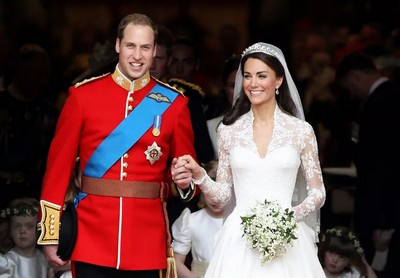
London: More than 15 years after Prince William and Kate Middleton exchanged wedding vows, their relationship continues to attract enormous public interest, not only because of their position at the heart of the British monarchy but also because of the partnership they have built through years of public duty, family life and personal challenges.
This autumn will mark another significant milestone in their story: 25 years since the future Prince and Princess of Wales first crossed paths as university students at the University of St Andrews in Scotland.
Their journey from first-year students to one of the world’s most recognisable royal couples has unfolded over a quarter of a century, encompassing courtship, marriage, parenthood, royal responsibilities and some of the most demanding periods of their lives.
While there is no universal formula for a successful marriage, royal biographer Russell Myers believes the strength of William and Kate’s relationship lies largely in the way they support one another, both in their private lives and in their demanding roles as senior working royals.
Myers, author of William and Catherine: The Monarchy’s New Era: The Inside Story, has described mutual support as a defining feature of their marriage. In his assessment, the couple’s ability to work together while raising their three children has helped them navigate the pressures that accompany life at the centre of the British royal family.
“The secret to the Prince and Princess of Wales’ marriage is support for one another throughout their roles as working royals and as parents to their three young children,” Myers said.
Their relationship, he argued, is characterised by a sense of partnership rather than the two pursuing entirely separate paths.
“Everything they do is in tandem,” Myers said, pointing in particular to Kate’s influence on William’s environmental ambitions.
One of the clearest examples of that partnership is the Earthshot Prize, an ambitious environmental initiative launched by William in 2020.
The project was conceived as a 10-year mission aimed at encouraging and supporting innovative solutions to some of the world’s most pressing environmental challenges. What began as a major royal initiative has since developed into an international platform bringing attention to environmental innovators from across the globe.
According to figures associated with the initiative, more than 5,600 emerging environmental solutions from 156 countries have been identified during its first six years.
Every year, five winners are selected across five categories, with each winner receiving a substantial financial award to help develop and expand their work. The prize has therefore sought not simply to recognise environmental ideas but to provide practical support that can help turn promising solutions into projects with wider global impact.
Myers has credited Kate with playing an important role in encouraging William when he had doubts about whether the initiative could achieve the international prominence it ultimately attained.
The Earthshot Prize has also become an increasingly global event. Rather than remaining tied to Britain, its annual awards ceremony has travelled between continents, reflecting William’s ambition to establish the project as an international movement.
The inaugural ceremony was held in the United Kingdom in 2021, followed by the United States in 2022, Singapore in 2023, South Africa in 2024 and Brazil in 2025.
The next chapter will take the awards to Mumbai, India, in November, where William is expected to be joined by Kate.
Her anticipated appearance would carry particular significance.
The event is expected to be Kate’s first attendance at an Earthshot Prize awards ceremony since 2022 and would also mark her first joint international engagement with William since her cancer diagnosis two years ago.
Kate’s health has been the subject of intense public attention since she revealed in 2024 that she was undergoing treatment for cancer. In January 2025, she announced that she was in remission, providing a major moment of relief for her family, supporters and the wider public.
Her return to major international royal duties alongside William would consequently represent more than another item on the royal calendar. It would signal another step in her gradual return to public life following a deeply challenging personal period.
The couple’s ability to balance professional responsibilities with family life has become particularly important as they raise their three children while preparing for increasingly significant roles within the monarchy.
William, as the heir to the British throne, carries responsibilities that will eventually place him at the centre of the institution. Kate, meanwhile, has developed a prominent public role of her own, particularly around children, families, early development, mental health and other social causes.
Their public image has increasingly been shaped by the idea of William and Kate operating as a team. Whether appearing at major ceremonial occasions, travelling overseas, meeting members of the public or supporting charitable initiatives, they frequently present themselves as partners working towards common objectives.
That partnership has been forged over a remarkably long period.
When they first met at St Andrews, neither could have known that their university romance would eventually lead to marriage and place them at the centre of the British royal succession. Their relationship survived the transition from student life to intense media attention, a period of separation before their engagement, marriage in 2011 and the subsequent demands of royal life.
They have since become parents to three children and taken on increasingly senior responsibilities within the monarchy.
Their story has therefore evolved far beyond the conventional narrative of a royal romance. It is now a story of two people who began their relationship as university students and have spent more than two decades growing into their public roles together.
As the 25th anniversary of their first meeting approaches, attention is likely to focus once again on the journey that took William and Kate from St Andrews to the heart of the British monarchy.
Their marriage has faced the extraordinary pressures that come with being constantly observed, while their family life has unfolded under an unprecedented level of public interest. Yet the picture presented by those close to their work is one of a couple who increasingly rely on each other as partners in both family life and royal service.
The forthcoming Earthshot Prize ceremony in Mumbai could provide another visible illustration of that partnership.
For William, it will be another stage in his long-term environmental campaign. For Kate, it could mark an important return to the international royal spotlight. And for both, it would reinforce the image of a royal couple whose public roles have become closely intertwined.
After 25 years since their story began and more than 15 years as a married couple, William and Kate’s relationship has entered a new phase — one in which personal partnership, family responsibilities and preparation for the future of the monarchy are increasingly inseparable.