

Newswire
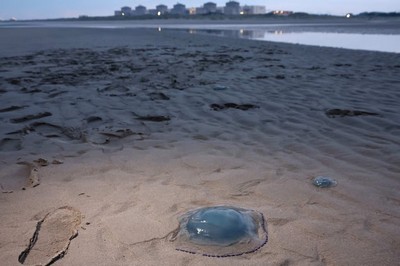
Paris: A massive swarm of jellyfish has forced the temporary shutdown of three reactors at France’s Gravelines nuclear power plant, prompting the operator to activate precautionary measures introduced after a similar incident brought the entire facility to a standstill last year.
Electricity company EDF said reactors 2, 3 and 4 at the nuclear plant in northern France were taken offline late Monday after large numbers of jellyfish entered the plant’s cooling-water system. Reactor 1 was also operating at only 50% of its capacity as a precaution, while reactor 5 was already offline for scheduled maintenance. Reactor 6 remained fully operational.
The incident highlights an unusual but recurring challenge for nuclear power plants located near coastal waters: marine life can enter cooling-water intake systems and obstruct equipment, potentially forcing operators to reduce or halt reactor operations.
Gravelines is one of France’s largest nuclear power facilities. Located in northern France and connected to the North Sea through a cooling canal, the plant has six reactors, each capable of generating around 900 megawatts of electricity, giving the facility a combined capacity of approximately 5.4 gigawatts.
EDF stressed that the jellyfish-related disruption posed no threat to the safety of the plant, its personnel or the surrounding environment.
The latest shutdown comes after the entire Gravelines facility was forced offline last year following a major jellyfish incursion.
Following that incident, EDF introduced additional monitoring and response measures designed to identify large swarms earlier and reduce their impact on the plant’s cooling systems.
The operator has installed fixed cameras at the water-intake canals and around filter-drum screens to detect incoming blockages as quickly as possible.
EDF has also established cooperation with a French fishing organisation and a sea-rescue organisation to monitor coastal waters for jellyfish concentrations.
When a large swarm is detected, fishing vessels can be deployed to carry out targeted trawling operations aimed at reducing the density of jellyfish before they reach the plant.
According to EDF, fishing boats were deployed on Saturday after an initial warning about the approaching swarm.
The early intervention helped limit the impact on the power station, although some jellyfish had already reached the plant and had to be removed from the cooling system.
EDF said specialised vacuum trucks were being used to clear the jellyfish that had accumulated at the facility.
The company said no new jellyfish were currently arriving, allowing cleanup operations to proceed and raising hopes that the affected reactors could be brought back online relatively quickly.
The incident therefore appears to have been contained without affecting the overall safety of the facility.
The unusual disruption has also drawn attention to broader environmental changes that could make similar incidents more frequent.
Scientists have warned that jellyfish swarms may become increasingly common because of a combination of factors, including rising global temperatures, the spread of invasive species, the loss of natural predators and overfishing.
Warmer marine environments can create conditions favourable to jellyfish populations, while changes in marine ecosystems can alter the balance between jellyfish and the species that normally prey on them.
For nuclear power operators that rely on large volumes of seawater or river water for cooling, such ecological changes can present an increasingly important operational challenge.
The jellyfish incident comes as France’s nuclear power industry is already dealing with weather-related constraints.
A fifth heatwave is expected to intensify during the week, raising concerns about further restrictions on nuclear generation as temperatures increase and water availability becomes more challenging.
French nuclear reactors can face operational limits during periods of extreme heat because their cooling systems depend on water temperatures and environmental conditions.
In addition to the problems at Gravelines, one reactor in northern France has reportedly remained offline for much of the summer because of low river levels.
Another reactor has experienced limited restarts and remained largely out of service during much of July.
The combination of high temperatures, low water levels and unusual marine events demonstrates the growing range of environmental challenges confronting France’s nuclear electricity system.
For EDF, the immediate priority at Gravelines is to complete the cleanup and restore the affected reactors to service as quickly and safely as possible.
The preventive measures introduced after last year’s shutdown appear to have helped the operator respond earlier to the latest jellyfish swarm, with monitoring systems providing advance warning and fishing boats deployed before the swarm reached the plant in full force.
With no new jellyfish reportedly entering the facility, EDF expects the cleanup operation to progress rapidly.
The incident nevertheless serves as a reminder that even highly controlled nuclear facilities can be vulnerable to environmental events far removed from conventional technical or mechanical failures.
As France continues to rely heavily on nuclear power for electricity generation, maintaining reliable reactor operations amid increasingly unpredictable environmental conditions is likely to become an important challenge for operators and policymakers alike.