

Newswire
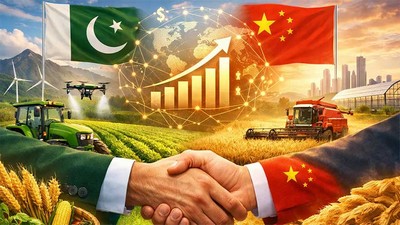
Islamabad: Pakistan has taken another significant step in deepening agricultural cooperation with China under the China-Pakistan Economic Corridor (CPEC), receiving 258 advanced agricultural machines and irrigation systems aimed at modernising farming practices, boosting productivity and accelerating the transition towards climate-resilient agriculture.
The latest shipment, provided under the CPEC agricultural cooperation framework, underscores the expanding scope of Pakistan-China collaboration beyond infrastructure into high-value sectors such as agriculture, biotechnology, digital farming and food security.
According to official documents on Friday afternoon, the machinery has been received and assembled by the Agricultural Engineering Institute of the Pakistan Agricultural Research Council (PARC) at the National Agricultural Research Centre (NARC) in Islamabad before being formally inaugurated and distributed among PARC and provincial governments for demonstration, testing and large-scale adoption.
The equipment package consists of nine categories of modern agricultural machinery designed to address multiple stages of crop production and irrigation. It includes 40 tractors, 20 rotary tillers, 30 rotary tillage fertiliser drills, 40 crawler-type rice-wheat combine harvesters, eight corn harvesters, 40 inter-tillage weeders, 40 trimmers, 20 hose-reel irrigation systems and 20 photovoltaic water-pumping systems.
The machinery has been distributed across Pakistan to maximise its outreach and demonstration potential. Punjab has received 75 units, Sindh 45, Khyber Pakhtunkhwa 38, Balochistan 36, while PARC has retained 64 units for research, technology validation and farmer training.
The initiative forms part of the Prime Minister’s Agriculture Modernisation Initiative, which seeks to transform Pakistan’s agriculture into a technology-driven, climate-smart and export-oriented sector capable of improving food security while increasing farm incomes.
Officials believe the introduction of Chinese agricultural machinery will help farmers reduce production costs, improve operational efficiency, increase crop yields and promote sustainable farming practices amid growing climate challenges.
The mechanisation programme is complemented by broader policy reforms introduced this year, including the National Agricultural Biotechnology Policy 2026 and National Seed Policy 2026, both of which aim to strengthen biotechnology research, improve crop genetics, commercialise high-yield seed varieties and enhance farmers’ access to climate-resilient technologies.
A major pillar of the Pakistan-China agricultural partnership is the growing institutional collaboration between PARC and the Chinese Academy of Agricultural Sciences (CAAS), one of China’s leading agricultural research organisations.
Earlier this year, the federal government granted in-principle approval to restructure PARC on the model of CAAS, signalling Islamabad’s intention to adopt China’s research-based approach towards agricultural development. A dedicated working group has already been constituted to oversee the institutional transformation.
Under the restructuring plan, five specialised Centres of Excellence will be established at NARC to focus on genome-based crop research, livestock genetics and disease management, climate-smart land and water management, artificial intelligence applications in agriculture, and food processing and value addition.
Another flagship component of the collaboration is the proposed Centre of Excellence for Advanced Agricultural Mechanisation and Digital Agriculture, to be developed jointly by PARC and CAAS.
The facility is expected to become Pakistan’s premier research hub for precision agriculture, artificial intelligence, robotics, drones, Internet of Things (IoT)-based farming systems and climate-smart agricultural machinery, facilitating technology adaptation, testing, commercialisation and farmer outreach.
Officials say the broader mechanisation agenda also includes drafting Pakistan’s first National Agricultural Mechanisation Policy, promoting domestic manufacturing of advanced farm equipment, establishing national machinery testing and certification systems, strengthening post-harvest mechanisation and expanding public-private Custom Hiring Centres to improve farmers’ access to modern machinery.
The initiative is also being supported through extensive human resource development under another flagship Pakistan-China cooperation programme.
Under the government’s plan to train 1,000 Pakistani agricultural graduates in China, 885 participants have already completed specialised training at leading Chinese institutions, while the remaining 115 are expected to depart shortly, completing the programme.
The graduates are receiving training in nine priority disciplines, including crop breeding and genomics, aquaculture, seed production, livestock breeding, disease surveillance, agricultural mechanisation, high-efficiency irrigation systems, artificial intelligence, drones and IoT-based farming technologies.
Upon returning to Pakistan, the graduates will serve as master trainers responsible for transferring Chinese expertise to farmers, researchers, extension departments and educational institutions, accelerating the adoption of hybrid seeds, precision agriculture, water-saving technologies and value-added agricultural production across the country.
Officials view the combined package of advanced machinery, institutional reforms and technology transfer as one of the most comprehensive China-supported agricultural modernisation efforts launched under CPEC, reflecting the growing strategic emphasis both countries are placing on food security, agricultural innovation and sustainable rural development.