
Abida Shaheen
Islamabad: Pakistan’s state-owned Oil and Gas Development Company Limited (OGDCL) this week signed a strategic agreement with Canada’s Synergetic Oil Tools Inc. to introduce advanced oilfield technology aimed at enhancing production from the country’s heavy crude oil wells, marking another step in Islamabad’s efforts to strengthen domestic energy output and reduce dependence on imported petroleum.
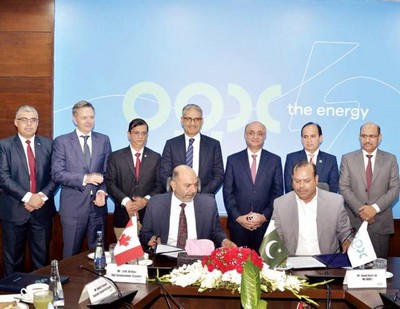
The agreement was signed in Islamabad in the presence of OGDCL Managing Director and Chief Executive Officer Ahmed Hayat Lak, Synergetic Oil Tools President and Chief Executive Officer Brian Herman, and Canadian High Commissioner to Pakistan Tarik Ali Khan.
Under the partnership, the Canadian company will deploy its proprietary Passive Energy Tool technology at OGDCL’s heavy oil fields. The technology is designed to improve production from highly viscous crude reservoirs by enhancing fluid flow characteristics, reducing the need for frequent well interventions, minimizing operational downtime, lowering production costs and decreasing reliance on chemical treatments during extraction.
Announcing the development, OGDCL said the agreement would facilitate the deployment of innovative production technology to optimize output from Pakistan’s heavy oil reserves, contributing to greater efficiency and improved recovery rates.
Speaking at the signing ceremony, Canadian High Commissioner Tarik Ali Khan said the collaboration reflects Canada’s commitment to supporting Pakistan’s energy sector through the introduction of world-class technology and technical expertise capable of improving heavy crude oil extraction and production.
The initiative comes as Pakistan intensifies efforts to expand indigenous oil and gas production in order to reduce its growing dependence on imported energy, which continues to place substantial pressure on the country’s foreign exchange reserves and external account.
According to official figures, Pakistan spent approximately Rs4.4 trillion (around US$16 billion) on petroleum imports last year, with the bulk of its crude oil and refined fuel supplies sourced from the United Arab Emirates, Saudi Arabia, Kuwait and Qatar.
Increasing domestic hydrocarbon production has become a central component of the government’s broader energy security strategy, which seeks to lower import costs, strengthen energy self-sufficiency and improve the country’s balance of payments.
The agreement with Synergetic Oil Tools also complements wider reforms underway in Pakistan’s energy sector. In recent months, the government has accelerated efforts to modernize refining infrastructure, improve operational efficiency and attract foreign investment into the petroleum industry.
Last month, Finance Minister Muhammad Aurangzeb held discussions with US-based industrial technology company Honeywell regarding refinery modernization initiatives, while government officials have also reaffirmed their commitment to advancing a long-delayed US$6 billion refinery upgrade programme aimed at enhancing Pakistan’s refining capacity and reducing reliance on imported petroleum products.
The latest partnership underscores Pakistan’s strategy of leveraging international technological expertise to unlock the potential of its domestic hydrocarbon resources while strengthening long-term energy security and supporting sustainable growth in the upstream oil and gas sector.