
Abdullah Jan
Islamabad: Writer and philanthropist Ali Rehman Malik has argued that many of society’s deepest disagreements stem from confusing explanations with descriptions, urging people to distinguish between observing reality and interpreting it.
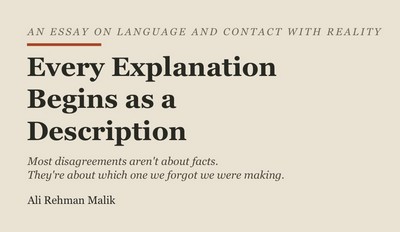
In an essay titled “Every Explanation Begins as a Description,” Malik contends that public discourse increasingly blurs the line between describing events and explaining why they occur, leading to misplaced certainty and deepening divisions.
Reflecting on recent debates dominating social media and news platforms, he noted that discussions frequently invoke broad concepts such as “the West,” “normal people,” “the media,” “democracy,” “freedom,” and “truth” without first questioning what those terms actually describe.
Malik said description is an attempt to identify what is being encountered, while explanation seeks to determine why it is happening. Although both are essential to understanding the world, he argued that they serve fundamentally different purposes and should not be treated as interchangeable.
He maintained that description itself is never entirely neutral because it requires people to assign names, draw distinctions and define boundaries around complex experiences. While language enables communication and shared understanding, it can also create the illusion that naming something amounts to fully understanding it.
Malik warned that once people become attached to labels, they often mistake symbolic representations for reality itself. As a result, explanations grow increasingly confident even as direct engagement with reality weakens.
He said the pattern extends beyond politics into religion, psychology, science, personal relationships and everyday thought. Individuals often experience an emotion, immediately assign it a label and construct an explanation, without reconsidering whether that explanation accurately reflects the experience.
Rather than embracing certainty, Malik advocated continual refinement of both descriptions and explanations. He argued that every description should be regarded as provisional and every explanation should remain open to revision, not because reality is unknowable, but because reality always exceeds the language used to describe it.
Malik stressed that language is intended to help people engage more closely with reality rather than replace it. He suggested that a more valuable question than asking whether an explanation is correct is to ask whether an explanation has been mistaken for a description, arguing that many of humanity’s deepest disagreements begin when that distinction is lost.