

Abdullah Jan
Islamabad: Philanthropist and Chairman of the Institute of Research and Reforms (IRR), Ali Rehman Malik, this week argued that recent controversy surrounding football officiating extends far beyond sport, reflecting a broader erosion of public confidence in institutions and the symbolic systems that underpin modern societies.
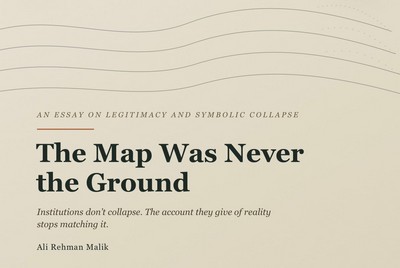
In an article titled “The Map Was Never the Ground: On symbols, legitimacy, and mistaking the collapse of one for the collapse of the other,” Malik said public outrage over a disputed disciplinary decision should not be viewed merely as a reaction to a football match, but as a manifestation of growing concerns about institutional legitimacy.

He argued that while controversial refereeing decisions are not uncommon, certain incidents resonate more deeply because they expose vulnerabilities in the frameworks people rely upon to interpret fairness, authority and justice.
According to Malik, modern societies function through shared systems of trust. Institutions such as courts, governments, financial systems and sporting bodies derive their authority not from force alone but from widespread public acceptance that established rules are applied fairly and consistently.
He maintained that these systems originated as practical solutions to specific problems but gradually evolved into accepted realities, with many people forgetting the original purpose behind the rules. When those frameworks appear inconsistent or open to external influence, confidence in the institutions themselves begins to weaken, he observed.
Malik stressed that such moments do not alter objective reality but instead affect public confidence in the symbolic structures used to understand and organise that reality.
Expanding the argument beyond sport, he said many democracies have witnessed declining trust in governments, media organisations, universities, corporations and international institutions, with individual controversies increasingly interpreted as evidence of wider institutional shortcomings.
He noted that institutions rarely lose public confidence because of a single error. Instead, trust gradually erodes when official narratives repeatedly fail to align with people’s lived experiences and meaningful corrective action is absent.
According to Malik, once institutions lose the benefit of public trust, routine administrative or procedural mistakes are increasingly viewed as signs of systemic failure rather than isolated incidents.
He argued that this represents not a collapse of reality itself, but a weakening of symbolic legitimacy, making it increasingly difficult for institutions to command public confidence.
Malik emphasised that symbols, including laws, constitutions, currencies, public offices and sporting regulations, remain essential for enabling cooperation within society, but cautioned against confusing those symbolic frameworks with reality itself.
He said the solution is neither to dismiss institutional failures nor to defend existing systems solely because they are longstanding, but rather to ensure that institutions continue to reflect the realities they were created to organise.
Concluding his analysis, Malik suggested that the intense public reaction to a disputed football decision reflected wider anxieties about the durability of modern institutions, arguing that distinguishing between reality and the symbolic frameworks through which societies understand it is essential to any meaningful debate about institutional legitimacy and reform.