
Italian-led archaeological project uncovers major ancient monument in Pakistan’s Gandhara region
Italian archaeologists lead excavation of 100-metre structure near Taxila, opening new avenues for research into Gandhara’s urban history and strengthening Pakistan-Italy scientific cooperation
Celina Ali
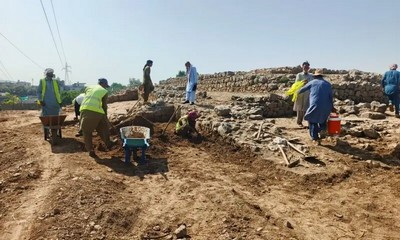
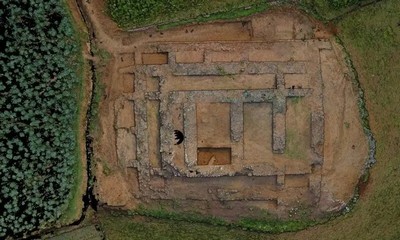
Islamabad: An Italian-led archaeological mission has uncovered a previously unstudied ancient monument measuring nearly 100 metres in length and 50 metres in width in Pakistan’s historic Gandhara region, highlighting the growing contribution of international scientific collaboration to the preservation and exploration of the country’s archaeological heritage.
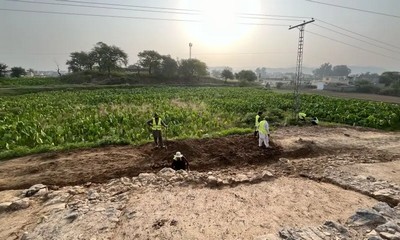
The discovery at Jandial, in Khyber Pakhtunkhwa’s Khanpur-Taxila region, has opened new avenues for understanding the historical development, urban landscape and monumental architecture of ancient Gandhara, according to an official press release issued on Friday.
The excavation is being carried out by the Khyber Pakhtunkhwa Archaeology Department under the Khyber PATH Project, directed by Italian archaeologist Dr Luca M. Olivieri and funded by the Italian Agency for Development Cooperation (AICS). The initiative underscores Italy’s continuing role in supporting archaeological research, cultural heritage conservation and scientific cooperation in Pakistan.
The newly identified monument, designated Jandial D, is located opposite the renowned Ionic temple of Jandial, just outside the fortified ancient city of Sirkap, one of the principal archaeological sites associated with the historic Taxila region.
Although the structure was first documented by British archaeologist Alexander Cunningham in 1864, it remained largely unexplored for more than a century. Excavations launched in mid-August 2026 have now brought substantial walls to light, providing researchers with fresh material for investigating the monument’s architectural design, historical significance and relationship with the surrounding ancient settlement.
Archaeologists have yet to determine whether the monumental structure served a public, religious or another function. Its considerable dimensions and strategic position near Sirkap have nevertheless raised important questions about the organisation of the ancient urban landscape and the role played by monumental buildings in the wider Gandharan region.
The findings are expected to contribute to a deeper understanding of the historical and architectural development of an area that served as an important crossroads of cultural interaction in South Asia.
Italy strengthens archaeological cooperation with Pakistan
The discovery reflects the contribution of Italian expertise and institutional cooperation to archaeological research in Pakistan, where centuries-old settlements, religious monuments and fortifications continue to offer opportunities for new historical discoveries.
The Khyber PATH Project is being implemented by the Italian Archaeological Mission of Ca’ Foscari University of Venice in collaboration with the Khyber Pakhtunkhwa Directorate General of Archaeology and Museums. The initiative is supervised by KP Director General of Archaeology and Museums Dr Abdul Samad, while Italian non-governmental organisation ISCOS has provided logistical and financial support.
Through the partnership, Italian researchers and Pakistani archaeological authorities are working together to investigate, document and conserve heritage sites across Khyber Pakhtunkhwa, combining international research expertise with local institutional knowledge.
The Jandial discovery demonstrates how renewed scientific investigation can bring previously overlooked archaeological remains into focus, even at sites that have been known to researchers for more than a century.
For Italy, the project also represents an important avenue for cultural and academic engagement with Pakistan, building cooperation around the study and preservation of shared human history. For Pakistan, the partnership offers opportunities to expand archaeological research, strengthen conservation practices and enhance understanding of the historical significance of its ancient civilisations.
Dr Olivieri said the discovery demonstrated the richness and unpredictability of the archaeological landscape in the region.
“Its monumental scale and strategic location raise important new questions about the ancient landscape of Sirkap and the wider Gandharan region,” he said.
The monument’s proximity to the Ionic temple of Jandial makes its investigation particularly significant. Researchers will need to establish the structure’s chronology, architectural characteristics and possible relationship with nearby archaeological remains before drawing firm conclusions about its purpose.
The excavation may also help clarify how the area surrounding Sirkap developed and how monumental structures were incorporated into the broader settlement pattern.
However, archaeologists have not yet established whether Jandial D was intended for religious ceremonies, civic activities or another purpose. Further excavation, documentation and scientific analysis will be required to determine its place in the history of the region.
The findings add to the continuing archaeological importance of the Khanpur-Taxila area, where successive historical periods and cultural influences have left a complex material record.
Dr Abdul Samad said the discovery highlighted the considerable archaeological potential of the Khanpur-Taxila region and the importance of sustained scientific investigation and international collaboration.
He also stressed the need to protect archaeological remains from the pressures of expanding urbanisation, which can threaten sites before their historical significance has been fully documented.
“The discovery at Jandial demonstrates that the archaeological landscape of KP continues to hold important historical secrets,” he said.
“Our priority is to support scientific research, strengthen international partnerships and protect these irreplaceable heritage assets.”
His remarks underline the challenge facing heritage authorities as development expands around historically significant locations. Continued research, effective conservation measures and cooperation between national and international institutions are essential to safeguarding archaeological sites for future generations.
The Jandial excavation forms part of the wider Khyber PATH Project, which has been operating for a year at eight archaeological sites across Khyber Pakhtunkhwa, extending from Swat to the Khanpur-Taxila region.
Beyond the investigation of Jandial D, the project includes excavation and conservation work on ancient fortifications at Sirsukh, as well as research at Bazira, also known as Barikot in Swat. Barikot is included on UNESCO’s Tentative List of World Heritage Sites.
The project’s geographical reach reflects the diversity of archaeological heritage across Khyber Pakhtunkhwa, where ancient urban settlements, defensive structures and other remains provide evidence of the region’s historical development and cultural connections.
By combining excavation with conservation, the initiative seeks not only to produce new historical knowledge but also to help preserve archaeological remains that might otherwise deteriorate or be damaged by modern development.
The discovery at Jandial is therefore significant both for the questions it raises about the ancient landscape of Gandhara and for the international partnership through which researchers are investigating it.
As excavations continue, the monument could provide further evidence about the architectural traditions, settlement patterns and public or religious spaces of ancient Sirkap, while reinforcing the importance of Italian-Pakistani cooperation in uncovering and protecting Pakistan’s archaeological heritage.