
Lisbon: From royals and Hollywood stars to sporting icons and the ultra-wealthy, Portugal is emerging as one of Europe’s most coveted addresses, offering sunshine, privacy, luxury and, above all, discretion.
Portugal has steadily transformed itself into one of Europe’s most desirable destinations for the global wealthy, celebrities and members of royal families seeking something increasingly difficult to find in the world’s traditional luxury hotspots: privacy without sacrificing comfort, sophistication or access.
From the golden beaches of the Alentejo coast to the elegant neighbourhoods of Lisbon and the exclusive communities around Cascais and Comporta, Portugal has become a magnet for people whose names regularly dominate headlines.
Princess Eugenie, Formula One champion Max Verstappen, football superstar Cristiano Ronaldo, Hollywood actors Michael Fassbender and Alicia Vikander, singer Madonna and designer Christian Louboutin are among the international names associated with the country’s luxury property market. Prince Harry and Meghan, Duchess of Sussex, have also reportedly acquired a holiday property in Portugal.
Yet Portugal’s attraction goes well beyond celebrity ownership and expensive villas. For many of its affluent newcomers, the real luxury is the ability to live relatively normal lives away from relentless public attention.
That combination of natural beauty, relaxed living and discretion has helped Portugal distinguish itself from more established celebrity destinations such as the French Riviera.
Princess Eugenie’s connection with Portugal illustrates the country’s growing appeal among the British royal circle.
Eugenie and her husband, Jack Brooksbank, reportedly bought a villa valued at about Dh18 million in the CostaTerra Golf and Ocean Club near Melides, on Portugal’s Alentejo coast. The exclusive development is part of a luxury residential community between Comporta and Melides, roughly an hour south of Lisbon, and has been described as the “Hamptons of Europe”.
Spread across hundreds of hectares, CostaTerra combines private residences with a golf course, wellness facilities, equestrian amenities and access to the Atlantic coastline.
Brooksbank’s professional association with the development has also strengthened the couple’s ties to the area.
For Eugenie, however, Portugal appears to offer something more valuable than a luxury retreat: anonymity.
Speaking about the country in 2023, she highlighted the freedom she felt there to dress casually, go shopping and move around without attracting attention.
That sense of normality is increasingly becoming one of Portugal’s most powerful selling points for high-profile residents.
The Duke and Duchess of Sussex have similarly drawn attention to Portugal. Meghan has shared glimpses of the family spending time there, including visits to beaches, shops and restaurants. The couple reportedly purchased a property at CostaTerra in 2024.
Even as the Sussexes have considered spending an extended period in Britain, reports have indicated that their Portugal property is expected to remain part of their international portfolio.
Portugal’s growing appeal among the ultra-rich is reflected in the numbers.
The country has recorded a sharp increase in its population of ultra-high-net-worth individuals. The number of people with net assets exceeding €25 million is estimated to have risen from about 1,462 in 2021 to 2,187 in 2026 — an increase of almost 50 per cent.
Several factors have contributed to the transformation.
Portugal offers a combination of warm weather, an attractive coastline, relatively relaxed living, strong infrastructure and access to the wider European market. For international investors, residency and tax policies have also historically played an important role.
The country’s Golden Visa programme helped attract foreign capital, while the Non-Habitual Resident regime introduced in 2009 provided tax incentives aimed at attracting skilled professionals and international residents.
Although Portugal has subsequently changed its tax and residency policies, the legacy of those measures remains visible in the country’s international property market.
For wealthy buyers, however, financial considerations are only part of the equation.
The broader attraction is lifestyle.
Portugal allows residents to combine high-end property and services with an environment that, in many places, still feels distinctly local. Its historic towns, traditional villages, uncrowded beaches and slower pace offer an alternative to the conspicuous luxury associated with some Mediterranean resorts.
Perhaps no Portuguese celebrity embodies the country’s luxury-property boom more than Cristiano Ronaldo.
The Portuguese football icon and his wife, Georgina Rodríguez, have been linked to some of the country’s most expensive real estate.
Spanish media have reported that Ronaldo spent around €25 million on a huge residence in the exclusive Quinta da Marinha development on the Cascais coast.
If the reported figure is accurate, the property would rank among the most expensive private residential purchases in Portugal.
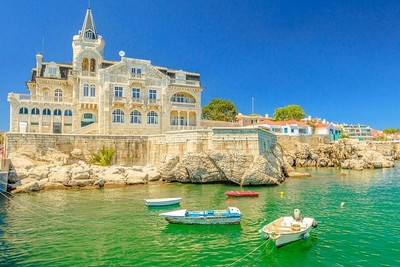
The location itself helps explain the appeal. Cascais, located west of Lisbon, combines beaches, upscale restaurants, golf courses, international schools and easy access to the capital while retaining an exclusive residential character.
For someone of Ronaldo’s global profile, the area also provides another crucial commodity: relative privacy.
Portugal’s appeal extends well beyond football and royalty.
Formula One world champion Max Verstappen and his partner, Kelly Piquet, have reportedly acquired a plot at the Pinheirinho Comporta luxury development with plans to build a private residence.
The development lies along the coastal region south of Lisbon and promotes a combination of golf, wellness, nature and low-density living.
Its appeal reflects precisely what affluent buyers increasingly seek — open spaces, proximity to nature, privacy and an environment where luxury is integrated into the landscape rather than displayed ostentatiously.
That distinction is important.
Portugal’s most desirable communities are not necessarily built around the flashy spectacle associated with some Mediterranean resorts. Instead, they emphasise architecture, nature, wellness and exclusivity.
The Portuguese property story also has a distinctly Hollywood dimension.
Michael Fassbender and Alicia Vikander moved to Lisbon in 2017 and have since established a strong connection with the Portuguese capital, where they have raised their family.
Vikander has compared Lisbon to New York’s Williamsburg, pointing to the city’s combination of historic character, creative energy and transformation.
Madonna, meanwhile, became one of Portugal’s most prominent celebrity residents after moving there with her family when her son David Banda joined Benfica’s youth football academy.
She bought Quinta do Relógio, an historic estate in Sintra, in 2017 for about €7.5 million. The expansive property reportedly features four bedrooms and seven bathrooms and became the singer’s Portuguese base before she eventually moved away from the country.
Madonna is understood to have retained ownership of the estate.
Other internationally recognised names, including George Clooney, Nicole Kidman and Scarlett Johansson, have also been linked in reports to Portuguese property or investment interests.
Among those who understood Portugal’s appeal long before the current celebrity rush was French footwear designer Christian Louboutin.
Louboutin has been visiting Comporta since the 1990s and developed a particularly strong relationship with the region.
In 2023, he opened Vermelho, a 13-room boutique hotel in Melides. The name, meaning “red” in Portuguese, is an unmistakable reference to the trademark red soles of his famous shoes.
For Louboutin, the attraction of the region lies partly in what it has not become.
Melides remains markedly different from the heavily commercialised resorts of the Mediterranean. Its appeal rests on beaches, pine forests, traditional architecture, local culture and a sense of quiet.
That authenticity is now itself a luxury.
Portugal’s rise raises an interesting question: why are the world’s wealthiest people increasingly choosing places where they can disappear rather than be seen?
The answer may lie in how luxury itself has changed.
For decades, celebrity property was associated with grand villas in Saint-Tropez, sprawling estates in Los Angeles or glamorous apartments in London, Paris and New York.
Today, privacy, space, security and authenticity can be more valuable than conspicuous displays of wealth.
Portugal offers all four.
A celebrity can spend a morning on a relatively quiet Atlantic beach, have lunch in a local restaurant and return to a highly secure luxury residence without necessarily becoming the centre of attention.
For public figures accustomed to paparazzi, social media scrutiny and constant exposure, that can be an extraordinary privilege.
Portugal’s popularity also brings a challenge.
As international wealth flows into Lisbon, Cascais, Comporta and the Alentejo coast, concerns about property prices, development and the preservation of local communities are likely to remain part of the conversation.
The very qualities attracting wealthy international buyers — authenticity, tranquillity and relatively undeveloped landscapes — could be threatened if development becomes excessive.
That is why Portugal’s emerging luxury market is different from the traditional celebrity playgrounds.
The country’s greatest selling point may be its refusal to become one.
Louboutin captured that sentiment when he warned that Melides should not be expected to become another Saint-Tropez.
For Portugal, that may ultimately be the most important lesson of its celebrity boom.
The world’s richest people are arriving because the country still feels real.
And as long as Portugal can preserve that sense of authenticity, its quiet corners of the Atlantic coast may remain among the most coveted second-home addresses in Europe.