

Newswire
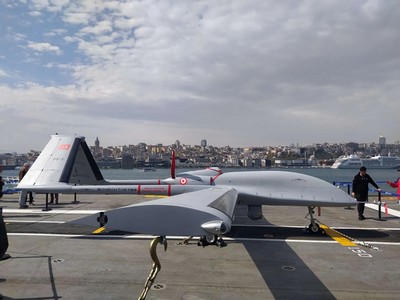
Rome: Leonardo and Turkish defence company Baykar have moved into the industrial execution phase of their new drone joint venture, beginning integration of the first aircraft in Italy and targeting initial customer deliveries before the end of 2026.
Leonardo Chief Executive Lorenzo Mariani disclosed the development during the company’s second-quarter 2026 earnings call, saying the first aircraft was already being integrated at Leonardo’s Ronchi dei Legionari facility.
The milestone marks a significant step forward for the partnership, which has progressed from the agreement and regulatory approval stage to actual aircraft production and integration in Italy.
Leonardo and Baykar signed the final agreement establishing the venture shortly before the earnings call. According to Mariani, the partnership has secured all required regulatory approvals in Italy and at the European level, clearing the way for industrial activity.
The companies are now preparing a series of presentations and demonstrations for potential customers. The planned activities are expected to showcase different applications of the aircraft and target prospective customers in both Italy and international markets.
Mariani did not disclose the identities of the customers expected to receive the first aircraft. He also did not provide details on the number of aircraft involved, their specific configurations or the financial value of the initial deliveries.
The first deliveries, however, are expected before the end of this year, making the programme one of Leonardo’s most immediate initiatives for expanding its presence in the rapidly evolving unmanned systems market.
The venture with Baykar forms part of Leonardo’s broader strategy of using industrial partnerships to accelerate entry into emerging technologies and new markets.
Mariani has stressed the importance of partnerships in responding to changing defence requirements, particularly where technological sovereignty and access to advanced capabilities have become increasingly important for European countries.
Such partnerships, he has argued, can provide access to technologies and industrial capabilities that could take considerably longer to develop independently.
The cooperation with Baykar is particularly significant given the Turkish company’s growing international profile in unmanned aerial systems. For Leonardo, the partnership offers an opportunity to combine its established aerospace and defence capabilities with Baykar’s expertise in unmanned aircraft and potentially expand the resulting products into international markets.
The rapid progress of the Baykar venture also reflects a wider emphasis within Leonardo on accelerating programme development and industrial execution.
Mariani has identified speed as an increasingly important element of the company’s industrial strategy, arguing that Leonardo needs to move faster in programme development, production, industrialisation and engineering to keep pace with rapidly changing customer requirements.
The Baykar programme is among the initiatives where Leonardo believes it has greater control over the timetable.
With regulatory approvals now completed, the partners have been able to move directly into aircraft integration and preparations for customer demonstrations, rather than waiting for further external decisions.
This distinguishes the project from programmes in which regulatory reviews, government decisions or other external factors can significantly affect the pace of development.
The start of aircraft integration at Ronchi dei Legionari represents the transition of the Leonardo-Baykar relationship from a strategic agreement into an operational industrial programme.
The immediate objective is to complete integration, conduct demonstrations for prospective customers and deliver the first aircraft before the end of 2026.
While important details about the initial orders remain undisclosed, the timetable signals Leonardo’s intention to rapidly translate the partnership into commercial and operational results.
The venture could also strengthen Italy’s role in the European unmanned-systems industry by creating an industrial base for the integration and potential production of advanced drone platforms on Italian soil.
For Leonardo, meanwhile, the partnership provides a route to expand its unmanned capabilities while strengthening cooperation with a major international defence technology company.
The first customer deliveries expected later this year will therefore provide an important test of the venture’s ability to move quickly from partnership formation to industrial-scale execution, while potentially opening the door to wider sales in Italy and international markets.