
Liaquat Ali
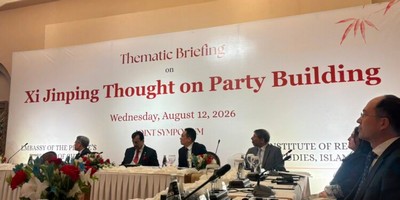
Islamabad: The Chinese Embassy in Pakistan and the Institute of Regional Studies (IRS) this week organised a thematic briefing on “Xi Jinping Thought on Party Building,” bringing together senior diplomats, political representatives, Chinese experts, academics, journalists and members of Pakistan’s policy community for an extensive discussion on China’s governance experience and its broader international significance.
A delegation of experts from the International Department of the Central Committee of the Communist Party of China (IDCPC) also participated in the event, which examined China’s approach to party building, governance, poverty alleviation, anti-corruption efforts, grassroots mobilisation and international party-to-party exchanges.
Chinese Ambassador to Pakistan Jiang Zaidong expressed appreciation for the opportunity to co-host the seminar with the Institute of Regional Studies and thanked President Asif Ali Zardari for his attention to the event and Senate Chairman Yousaf Raza Gilani for attending the gathering.
He also expressed gratitude to the Chinese experts who travelled from Beijing to participate in the briefing, as well as representatives of Pakistani political parties, experts, journalists and people from different walks of life for their participation.
Ambassador Jiang described the presentations by the Chinese experts as comprehensive and in-depth, saying they had provided valuable insights into Xi Jinping Thought on Party Building and its practical application.
He also welcomed the remarks by IRS Chairman Jauhar Saleem, saying the joint study and discussion between the Chinese and Pakistani sides was timely and necessary and would promote greater mutual learning and understanding.
The ambassador said Xi Jinping Thought on Party Building was profound and wide-ranging and called for continuous efforts to study, understand and apply its principles. He stressed that the process should also involve reflection on individual responsibilities, institutional performance and the broader objectives of governance.
Jiang said the experience of the Communist Party of China demonstrated the importance of placing people at the centre of development and ensuring that economic and social progress translated into tangible improvements in people’s lives.
He said Xi Jinping Thought on Party Building emphasised remaining true to the original aspiration and founding mission of the CPC, which he described as seeking happiness for the Chinese people and rejuvenation for the Chinese nation.
Referring to China’s campaign to eliminate absolute poverty, the ambassador highlighted President Xi Jinping’s extensive field research and engagement with poverty-stricken areas.
He said Xi had undertaken more than 50 field research visits on poverty alleviation, covering all 14 contiguous poor regions of China, and had developed the concept of targeted poverty alleviation on the basis of extensive investigation.
According to Jiang, the campaign ultimately enabled China to eliminate absolute poverty and build a moderately prosperous society in all respects, before embarking on a new phase of national rejuvenation and Chinese modernisation.
He said more than three million first Party secretaries and resident cadres, nearly two million township officials and millions of village-level cadres had participated in the nationwide effort.
The ambassador described the campaign as an example of the CPC’s ability to mobilise resources and institutions to accomplish major national objectives.
He said the experience reflected what he termed two core principles of Xi Jinping Thought on Party Building: the leadership of the CPC as the defining feature of socialism with Chinese characteristics and the importance of upholding the centralised and unified leadership of the CPC Central Committee.
Jiang argued that the CPC’s emphasis on people’s well-being had contributed to its continuing popular support and its role as what he described as a reliable backbone of Chinese society.
He added that China’s development objectives extended beyond domestic prosperity, saying the CPC also sought progress for humanity and the common good of the international community.
Turning to Pakistan-China relations, the ambassador said this approach was reflected in China’s engagement with Pakistan and its emphasis on development and people’s livelihoods.
He said President Xi Jinping had consistently attached importance to Pakistan’s national development and the welfare of its people and had worked with Pakistani leadership to define a new direction for the China-Pakistan all-weather strategic cooperative partnership.
Jiang said Xi had emphasised that China’s friendly policy towards Pakistan was directed towards the entire Pakistani people and that the planning and implementation of the China-Pakistan Economic Corridor (CPEC) should take into account all regions of Pakistan so that development benefits could reach people across the country.
According to the ambassador, CPEC has so far brought more than $25.9 billion in direct investment, created over 260,000 jobs, added more than 8,000 megawatts of power-generation capacity, constructed 510 kilometres of highways and developed 886 kilometres of core national power transmission networks.
He described CPEC as an important contributor to Pakistan’s socio-economic development and a significant example of high-quality Belt and Road cooperation.
Jiang said China remained ready to work with Pakistan to advance both major strategic projects and smaller livelihood-oriented initiatives aimed at improving public welfare and promoting common prosperity.
The ambassador also highlighted the role of Chinese private enterprises in Pakistan, recalling a recent visit to an industrial park in Faisalabad.
He said the delegation learned that 39 Chinese private companies were operating in the industrial park, with most of them running soundly and profitably in what he described as an enabling business environment.
He said Chinese companies were also contributing to local communities, citing five ceramic enterprises that, according to him, collectively pay nearly $20 million in annual taxes and provide more than 5,000 jobs.
Jiang described these activities as examples of how bilateral cooperation could generate tangible benefits for both countries and their peoples.
The ambassador said economic cooperation should be complemented by greater mutual learning in party governance and state administration, particularly as the international system enters a period of profound change and political parties around the world face common governance challenges.
He said Xi Jinping Thought on Party Building provided a global perspective by linking the CPC’s efforts to strengthen itself with broader questions concerning human development and governance.
Jiang argued that the experience could offer useful references for political parties, particularly in developing countries, seeking to strengthen their organisations and explore independent paths towards modernisation.
He stressed that political parties should strengthen mutual trust, communication and cooperation while respecting differences and national circumstances.
The ambassador also highlighted growing exchanges between the CPC and Pakistani political parties, noting that the two sides had signed a memorandum of understanding on inter-party exchanges and cooperation, established a political party consultation mechanism for CPEC and organised the China-Pakistan Political Parties Forum.
He said China regularly invited representatives of Pakistani political parties to visit the country for study tours and conferences and continued to support small-scale livelihood projects in Pakistan through initiatives such as the Silk Road Workshop.
Jiang noted that 2026 marks the 75th anniversary of the establishment of diplomatic relations between Pakistan and China, describing the milestone as an opportunity to further consolidate bilateral relations.
He said a senior delegation of Pakistani political parties had visited China’s Hubei Province in May, contributing to efforts to expand local cooperation between the two countries.
He added that the second China-Pakistan Political Parties Forum and a meeting of the Political Party Consultation Mechanism for CPEC were also held in May, with leaders from 12 major Pakistani political parties participating.
According to the ambassador, the two sides reached broad consensus on strengthening traditional friendship and advancing practical cooperation.
Jiang said the Islamabad seminar represented another step towards deepening exchanges on party building and governance between China and Pakistan.
He said China was ready to work with political parties across Pakistan to implement the important understandings reached by the leadership of the two countries and expand what he termed “political party-plus” cooperation.
He expressed confidence that stronger inter-party exchanges and mutual learning would provide additional momentum to the China-Pakistan all-weather strategic cooperative partnership and contribute to building a closer China-Pakistan community with a shared future in the new era.
During the seminar, Professor Zheng Huan of the Party Building Department at the Party School of the CPC Central Committee delivered a presentation examining the development and international significance of Xi Jinping Thought on Party Building.
He said the concept, developed following the 18th CPC National Congress in 2012, provided guidance for comprehensive and rigorous Party self-governance, strengthening Party organisations and maintaining the long-term vitality of the CPC.
Zheng outlined five major contributions that he said the concept offered to political parties confronting governance and development challenges.
The first related to long-term national development strategies and stable development policies that extend beyond electoral cycles. He highlighted China’s economic progress under the 14th Five-Year Plan and referred to major milestones in the country’s GDP growth.
He also highlighted China’s targeted poverty alleviation campaign, under which nearly 100 million rural residents were lifted out of absolute poverty over an eight-year period.
The second contribution concerned strengthening public confidence through citizen-centred governance.
Zheng said the CPC sought to represent the broader public rather than special interest groups, privileged strata or powerful cliques, while placing public welfare at the centre of governance.
The third area concerned the CPC’s extensive grassroots organisational structure.
He said the CPC had more than 101 million members and approximately 5.43 million primary-level Party organisations across China.
According to Zheng, this organisational network had facilitated large-scale mobilisation for local development, poverty alleviation, disaster relief and other national priorities.
The fourth contribution highlighted China’s approach to combating corruption through a comprehensive strategy aimed at making officials “not dare,” “not able” and “not want” to engage in corrupt practices.
Zheng said that between the 18th and 20th CPC National Congresses, anti-corruption authorities handled more than 4.64 million cases and disciplined around 4.57 million individuals, including 553 provincial- and ministerial-level officials.
He said institutional oversight, stronger enforcement and ideological and moral education were being used to close loopholes, prevent rent-seeking and strengthen integrity in public administration.
The fifth contribution was described as a new approach to international party-to-party relations based on non-interference, mutual respect and inclusive dialogue.
Zheng said the CPC maintained regular exchanges with more than 700 political parties and organisations in over 170 countries, describing such engagement as an important mechanism for mutual learning and international cooperation.
He also outlined a three-step approach to strengthening international understanding and academic research on Xi Jinping Thought on Party Building.
The first step, he said, was to deepen theoretical research into its Marxist origins, cultural foundations and practical experience in comprehensive and rigorous Party self-governance.
The second involved translating political concepts into accessible international language and connecting them with shared values to promote greater understanding.
The third called for increased cooperation among governments, media organisations and think tanks to establish dialogue platforms and jointly address common global governance challenges.
IRS Chairman Jauhar Saleem, representatives of various Pakistani political parties, experts and members of the journalist community also participated in the event.
Participants discussed China’s development experience, governance model and party-building practices, while appreciating China’s economic and social development and its efforts to promote cooperation with Pakistan.
The seminar provided another platform for expanding institutional and political exchanges between Pakistan and China at a time when the two countries are celebrating 75 years of diplomatic relations and seeking to further deepen their all-weather strategic cooperative partnership.