
Gwadar Pro
Islamabad: China this week reaffirmed its commitment to supporting Pakistan’s healthcare sector by donating US$2 million worth of reproductive health and family planning supplies and medical equipment, an initiative expected to improve maternal and newborn healthcare services for more than 300,000 women and girls across underserved districts.
The assistance was provided by the Government of China in collaboration with the United Nations Population Fund (UNFPA) as part of Beijing’s broader commitment to advancing healthcare cooperation under the Global Development Initiative (GDI) and South-South Cooperation Programme.
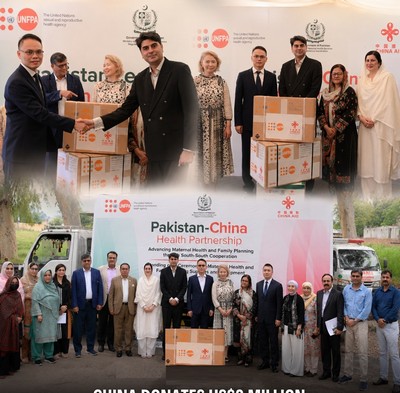
The equipment was formally handed over to Pakistan’s Ministry of National Health Services, Regulations and Coordination during a ceremony held at the Rural Health Centre (RHC) Tarlai in Islamabad.
Minister of State for National Health Services Malik Mukhtar Ahmad Bharat received the donation from Zhang Datuo, Second Secretary at the Embassy of the People’s Republic of China, in the presence of UNFPA Pakistan Deputy Representative Dr. Gulnara Kadyrkulova, Director General of the Population Programme Wing Dr. Shabana Saleem, and District Health Officer Islamabad Dr. Syeda Rashida Batool.
The Chinese assistance package includes reproductive health kits, midwifery equipment, two-rod contraceptive implants, clean delivery kits and newborn baby kits, all aimed at strengthening maternal, newborn and reproductive healthcare services in some of Pakistan’s most underserved regions.
The supplies will be distributed across 10 districts, including Kech, Loralai and Khuzdar in Balochistan; Hyderabad in Sindh; Rahim Yar Khan and Kasur in Punjab; Charsadda in Khyber Pakhtunkhwa; Gilgit in Gilgit-Baltistan; and Kotli in Azad Jammu and Kashmir.
Besides supplying medical equipment, the programme also includes specialised training for healthcare professionals to improve the quality of reproductive health services, strengthen maternal care and expand access to modern family planning options.
The initiative is expected to strengthen Pakistan’s maternal and newborn healthcare system while improving health outcomes in remote and disadvantaged communities through modern equipment, better-trained medical staff and expanded access to essential reproductive health services.