
Sofia: Bulgaria and Greece this week agreed to deepen security cooperation by establishing a joint police and customs cooperation centre at their shared border, marking a significant step toward strengthening efforts to combat illegal migration, organised crime and cross-border trafficking.
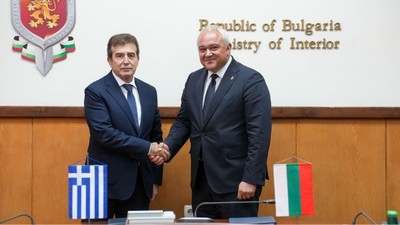
The agreement was reached during talks in Sofia between Bulgarian Interior Minister Ivan Demerdzhiev and Greek Minister for Citizen Protection Michalis Chrysochoidis, who reaffirmed their commitment to enhancing bilateral cooperation in law enforcement and border security.
The two ministers discussed a broad range of shared security challenges, including illegal migration, drug trafficking, human trafficking, arms smuggling, contraband and corruption, emphasizing the importance of closer operational coordination between the neighboring European Union member states.
As part of the meeting, the ministers signed an agreement establishing a Joint Police and Customs Cooperation Centre at the Kulata–Promachonas border crossing. The facility is expected to serve as a hub for information sharing, intelligence coordination and joint operational planning aimed at improving the detection and prevention of cross-border criminal activities.
The two sides also signed a protocol on conducting joint police patrols along their internal European Union border, reflecting efforts to strengthen surveillance and improve coordinated responses to security threats despite the absence of routine border controls within the Schengen framework.
In addition, Bulgaria and Greece adopted a joint declaration outlining common procedures for cross-border hot pursuit, enabling law enforcement authorities from both countries to coordinate more effectively when pursuing criminal suspects across national boundaries in accordance with European legal frameworks.
Speaking after the meeting, Interior Minister Demerdzhiev described Greece as one of Bulgaria’s key strategic partners in safeguarding regional security. He highlighted the close cooperation between the two countries in tackling organised crime networks involved in narcotics trafficking, human smuggling, illegal arms trading and other forms of transnational crime.
Demerdzhiev also disclosed that Bulgarian authorities had sought Greece’s assistance in tracing assets linked to individuals suspected of corruption and organised criminal activity, underscoring the growing emphasis on financial investigations as part of broader anti-corruption efforts.
The latest agreements reflect the two countries’ shared determination to strengthen border management and enhance law enforcement cooperation in response to increasingly complex regional security challenges.
Officials from both governments said the expanded partnership would improve intelligence sharing, facilitate faster operational coordination and reinforce efforts to combat transnational criminal networks while contributing to greater security along one of the European Union’s southeastern frontiers.