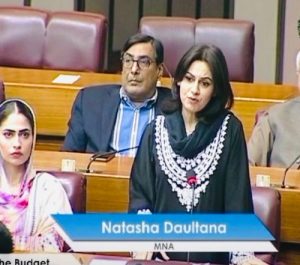
Budget debate underscores middle-class squeeze, PPP’s Natasha Daultana tells National Assembly
Celina Ali
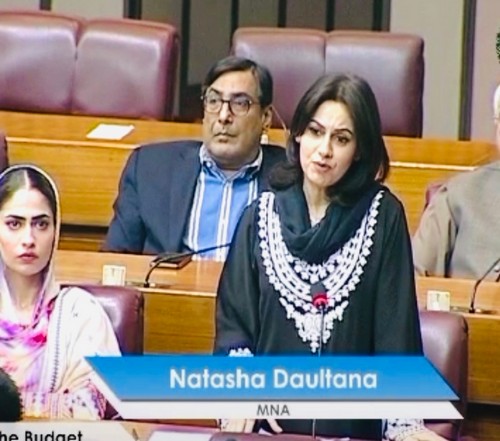
Islamabad: Pakistan People’s Party (PPP) leader and Member National Assembly Natasha Daultana on Thursday used her budget speech to highlight growing economic pressures on the middle class, while also describing recent political and institutional developments as a “victory of democracy and public trust.”
Speaking during the National Assembly budget debate, Daultana said she would avoid repeating points already raised by other lawmakers, noting that several “important and valid issues” had already been discussed in the House. In a lighter remark, she added that if she repeated any point, members could “bear with her as usual.”
She congratulated President Asif Ali Zardari, crediting his “tireless efforts” and referring to the Gilgit-Baltistan Order 2009 as a significant political milestone whose impact, she said, was now becoming visible. She also extended felicitations to PPP Chairman Bilawal Bhutto Zardari and Aseefa Bhutto Zardari on the party’s performance in the Gilgit-Baltistan elections, describing it as a reflection of continued public trust in the party’s leadership.
Daultana further lauded what she termed the broader role of national leadership, including Field Marshal Syed Asim Munir and Prime Minister Shehbaz Sharif, saying their efforts had contributed to easing regional tensions and strengthening diplomatic engagement.
Turning to the federal budget, the PPP lawmaker acknowledged the government’s decision to increase salaries of public sector employees, calling it a “welcome step” in the prevailing economic conditions and noting that “something is better than nothing.”
However, she cautioned that the budget still falls short of addressing structural economic pressures, warning that Pakistan’s middle class is “gradually shrinking” under inflationary and fiscal stress. She questioned whether teachers, young professionals, and small business owners felt represented in current economic policies, urging policymakers to align budgetary priorities more closely with ground realities faced by ordinary citizens.