
Liaquat Ali
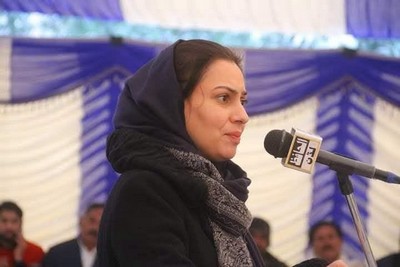
Islamabad: Pakistan Peoples Party (PPP) leader Natasha Daultana this week criticised the government’s handling of the agriculture sector, accusing the Pakistan Muslim League (Nawaz) administration of repeatedly adopting policies that have left farmers facing uncertainty and financial hardship.
Speaking about the situation confronting the farming community, Daultana said agriculture remained the backbone of Pakistan’s economy and that farmers deserved consistent policies, fair returns and greater government support rather than decisions that created uncertainty in agricultural markets.
She alleged that farmers had repeatedly suffered because of what she described as inconsistent government decisions concerning essential commodities, particularly sugar and wheat.
Daultana questioned the government’s approach to sugar, saying the authorities had first allowed or facilitated imports and were now moving towards exports, creating confusion over the country’s actual supply requirements.
“Farmers are the backbone of the country, but under the PML-N government they have always remained worried,” Daultana said.
She also raised concerns over the wheat situation, alleging that Pakistan was once again facing a wheat crisis and relying on imports to meet domestic requirements.
The PPP leader argued that the repeated need to import essential agricultural commodities pointed to shortcomings in the government’s planning and agricultural policy.
She said farmers were being placed in a difficult position as they struggled with uncertainty over crop prices, government procurement decisions and the availability of key commodities in the domestic market.
Daultana’s criticism comes amid wider political debate over the management of Pakistan’s agriculture sector, with opposition parties increasingly focusing on the difficulties faced by farmers and the government’s handling of food security.
She said farmers could no longer remain silent over policies that, in her view, were adversely affecting their livelihoods.
According to Daultana, the farming community was preparing to mobilise and raise its concerns more forcefully, with farmers likely to take to the streets to demand political accountability.
She said the farmers would eventually come out in protest and demand the resignation of Punjab Chief Minister Maryam Nawaz.
The PPP leader framed the issue as one extending beyond the interests of farmers, arguing that weaknesses in agricultural policy could have direct consequences for Pakistan’s food security, imports, prices and broader economy.
Agriculture remains a critical component of Pakistan’s economic structure, supporting a large share of the population and contributing significantly to rural employment and national production.
Daultana argued that a government seeking sustainable economic growth could not afford to overlook the concerns of farmers or adopt policies that left producers uncertain about whether their crops would receive adequate returns.
She particularly criticised what she described as a lack of consistency in government decisions, saying the contrasting moves on sugar and wheat demonstrated the need for a more coherent approach to agricultural and food-security planning.
The PPP leader maintained that farmers needed policies that were predictable and designed around long-term domestic requirements rather than short-term responses to changing market conditions.
Her remarks also gave the issue a political dimension, with Daultana warning that continued dissatisfaction among farmers could develop into a wider movement against the Punjab government.
She said the farming community was increasingly prepared to make its grievances heard and demand changes in government policy.
Daultana’s comments are likely to add to pressure on the provincial administration as opposition parties seek to highlight economic difficulties faced by rural communities and question the government’s performance in managing essential commodities.
For the PPP leader, the central issue is the treatment of farmers, whom she described as the backbone of the country.
She argued that protecting their interests was essential not only for rural livelihoods but also for ensuring stable food supplies and reducing Pakistan’s dependence on imports.
Daultana called for greater attention to agricultural planning and criticised the government for what she portrayed as a cycle of policy decisions that first created shortages and then required corrective measures.
She warned that unless the concerns of farmers were addressed, political pressure on the government would continue to grow.