
Abdullah Jan
Islamabad: The modern crisis surrounding “truth” may be less about people abandoning objective reality and more about growing disagreement over how truth should be established, whose evidence should be trusted and which institutions should be considered credible, argues philanthropist Ali Rehman Malik.
In an article, Malik contends that contemporary debates over truth, expertise and misinformation are often misunderstood because the word “truth” itself carries a wide range of assumptions and experiences that people interpret differently.
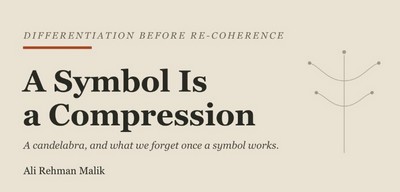
Drawing on an earlier essay, A Symbol Is a Compression, Malik uses the example of a candelabra to explain how apparently simple objects and words can accumulate layers of meaning. A candelabra may simply be a metal object designed to hold candles, he writes, but it can simultaneously evoke ritual, romance, wealth, religious spaces, funerals, Gothic architecture, craftsmanship, history and shadow.
The same process, Malik argues, applies to language and particularly to the concept of truth.
According to him, the word “truth” can encompass observation, measurement, mathematical proof, scientific replication, institutional authority, professional expertise, personal testimony, historical memory, moral intuition, narrative coherence and lived experience.
Different people may assign different levels of importance to these elements while continuing to believe they are defending the same underlying principle.
“One person may place greatest trust in empirical method, reproducibility and established institutions,” Malik writes, while another may rely more heavily on direct experience, historical patterns and memories of institutions that have previously distorted or restricted what was accepted as knowledge.
The resulting conflict, he argues, is not necessarily resolved simply by identifying the correct conclusion because disagreement can begin much earlier — with competing definitions of credible evidence and authority.
Malik stresses that acknowledging different approaches to knowledge does not mean treating all claims as equally valid. One person can be wrong, he says, and both sides can also be wrong.
The more fundamental problem, in his view, is that individuals can mistake their own standards for establishing credibility as the universal meaning of truth itself.
This perspective also complicates the increasingly common description of contemporary society as living in a “post-truth” era.
Malik acknowledges the existence of misinformation, propaganda, deliberate distortion and manufactured confusion. But he argues that “post-truth” can become an overly compressed explanation for a much more complicated phenomenon involving political resentment, declining institutional trust, emotional reasoning, changes in media technology and institutional failures.
Rather than assuming that people have simply stopped caring about truth, Malik suggests that many may instead have stopped trusting the same pathways towards establishing it.
“That distinction matters,” he argues.
A person who distrusts an institution, he notes, is not automatically rejecting objective reality. Such distrust may be irrational, but it may also emerge from remembered institutional failures, undisclosed incentives, exclusion from decision-making or historical cases in which official claims were subsequently shown to be false.
At the same time, Malik cautions that distrust itself cannot be treated as evidence that an alternative claim is correct.
The challenge, therefore, is to rebuild the relationship between institutions and the public rather than assuming that institutional titles or positions of authority are sufficient to restore credibility.
Malik argues that expertise should not be understood simply as a status attached to an individual or institution. Instead, it is a relationship involving competence, methodology, evidence, transparency, correction and public trust.
An expert can possess genuine knowledge without being infallible, while an institution can deserve considerable authority without becoming immune to scrutiny.
Likewise, members of the public may have legitimate reasons for distrust while simultaneously becoming vulnerable to false information deliberately designed to exploit that distrust.
The tension becomes particularly visible in the opposing demands frequently heard in public debate: “Trust the experts” on one side and “Do your own research” on the other.
Malik argues that both phrases can conceal assumptions that prevent meaningful dialogue.
Those urging people to trust experts may be heard as demanding submission to institutions that have demonstrated their fallibility. Those encouraging people to conduct their own research may, in turn, be understood as suggesting that personal intuition or isolated information should carry the same weight as accumulated evidence.
The dispute, therefore, is often not simply about competing conclusions but about the routes through which conclusions are granted authority.
Malik believes modern media environments intensify this problem because they reward short, emotionally powerful expressions capable of carrying large amounts of meaning.
Labels such as “extremist”, “elitist”, “traitor”, “victim”, “expert” or “propagandist” can become miniature verdicts, he argues, allowing a single word to perform work that would otherwise require evidence, context and explanation.
The faster such labels circulate, the less opportunity there is to unpack the assumptions and experiences contained within them.
This produces what Malik describes as a form of “symbolic collision”, in which people respond not only to the literal meaning of a word but also to the history, loyalties, grievances and expectations they associate with it.
He extends the argument beyond truth to other politically and socially charged concepts, including freedom, nation, family and justice. Each, he suggests, contains multiple histories and relationships, allowing people to hear radically different meanings in the same word.
For Malik, the answer is not to abandon compressed language. Such compression is indispensable to human communication and civilisation. Nor does he advocate treating every interpretation of a shared term as equally legitimate.
Instead, he calls for a willingness to reopen compressed concepts when they begin generating more conflict than understanding.
That process, he argues, requires asking difficult questions about how knowledge is being established: which forms of evidence are being given the greatest weight, which authorities are being relied upon, what historical experiences produced distrust, what institutional incentives have been disclosed, and whose experiences are being included or excluded.
It also requires examining whether parts of a symbol still accurately describe the world or have instead become expressions of memory, aspiration, fear or institutional habit.
Malik ultimately argues for a balance in which competing sources of knowledge can be recognised without abandoning standards of evidence.
Personal testimony can be important without automatically overriding other forms of evidence, he maintains. Institutional expertise can deserve substantial weight without becoming immune to correction. Historical distrust can be understandable without making every opposing claim true.
The objective, he suggests, is not to destroy the concept of truth but to restore a functioning relationship between language, institutions, evidence and reality.
Truth, in this framework, becomes more reliable rather than weaker when its methods and assumptions are examined.
Similarly, expertise can become more deserving of public confidence when its limitations are openly acknowledged, while distrust becomes useful only when it remains accountable to evidence rather than turning past injury into an unquestionable explanation of present reality.
Malik concludes that symbols are essentially maps folded small enough to carry — and truth is no exception.
But a folded map remains useful only when people remember that the terrain itself has not disappeared inside it.
The task, he argues, is therefore not necessarily to force everyone onto a single intellectual road, but to ensure that every road remains answerable to the same underlying reality.