
Celina Ali
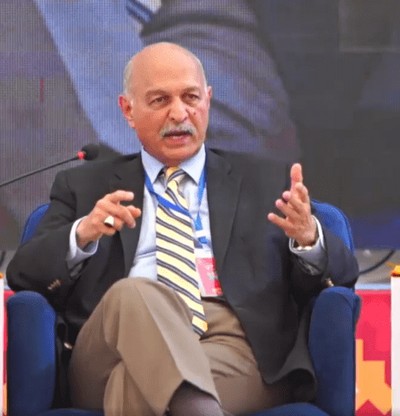
Islamabad: Pakistan’s role in promoting regional peace and China’s growing influence in shaping an emerging global order came into sharp focus at the World Peace Forum in Beijing, where Senator Mushahid Hussain Sayed said the post-World War II Western-led international system was steadily losing credibility because of what he described as persistent double standards.
Delivering the keynote address at the prestigious World Peace Forum, organised by Tsinghua University thus week, Mushahid argued that the international community was witnessing a historic geopolitical transition in which countries of the Global South were assuming a greater role in global governance. He maintained that the existing Western-led rules-based order had failed to ensure either genuine international order or the consistent application of universally accepted rules, creating space for the emergence of a more inclusive and balanced international system.
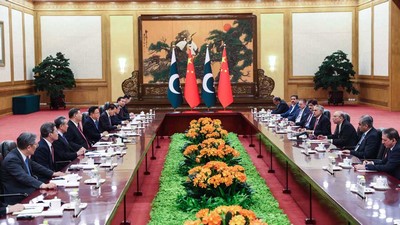
The forum brought together nearly 100 policymakers, diplomats, academics and strategic experts from around 30 countries. Chinese Vice President Han Zheng inaugurated the conference, while former foreign ministers, senior diplomats and international scholars discussed evolving security challenges and prospects for global peace.
Participants praised Pakistan’s diplomatic engagement in South Asia and the Middle East, describing Islamabad’s proactive regional outreach as an important contributor to peace, stability and dialogue at a time of heightened geopolitical tensions.
Highlighting the significance of 2026 as the 75th anniversary of diplomatic relations between Pakistan and China, Mushahid described bilateral ties as a unique model of strategic cooperation that had evolved from traditional neighbourly relations into an enduring partnership between “Iron Brothers.”
He said the recently adopted Pakistan-China Strategic Work Plan for 2026-2030 would provide a comprehensive roadmap for broadening cooperation in political, economic, technological, security and people-to-people sectors over the next five years.
The senator praised China’s peaceful rise on the global stage, attributing Beijing’s growing influence to what he described as the wisdom of a civilisation spanning more than five millennia. He said China’s development had been achieved without pursuing aggression, military occupation or colonial expansion, enabling it to emerge as one of the world’s foremost powers.
Referring to changing global power dynamics, Mushahid noted that China’s expanding international stature had been increasingly acknowledged worldwide, reflecting its central role in international diplomacy and economic development.
He further argued that China’s technological advancement and diplomatic engagement had significantly enhanced its international standing during recent regional crises. According to Mushahid, Beijing’s growing credibility stemmed from its ability to maintain dialogue with all sides while avoiding military confrontation and positioning itself as a trusted partner in conflict resolution.
Drawing comparisons between regional organisations, Mushahid contrasted the success of the Association of Southeast Asian Nations (ASEAN) with the limited effectiveness of the South Asian Association for Regional Cooperation (SAARC). He attributed ASEAN’s success to Indonesia’s inclusive and consensus-driven leadership, while arguing that unequal regional dynamics had constrained SAARC’s ability to realise its full potential.
Concluding his speech, Mushahid recalled his first visit to China as a student during the early 1970s and quoted Chairman Mao Zedong’s famous words, “Nothing is hard in this world if you dare to scale the heights,” a remark that received warm applause from the international audience.
During his visit to China, Mushahid also participated in a high-level international conference in Ningxia on “Xi Jinping Thought and Poverty Alleviation,” organised by the International Department of the Communist Party of China (IDCPC).
Chairing a dialogue involving scholars and political representatives from China, Kyrgyzstan, Nepal and Cambodia, he praised China’s internationally recognised poverty reduction programme, noting that approximately 800 million people had been lifted out of poverty over four decades, resulting in the elimination of absolute poverty across the country.
The conference attracted around 150 political leaders, academics, media representatives and think tank experts from Asia, Africa, Europe, Latin America and North America, highlighting China’s growing role in promoting development cooperation and governance exchanges with the Global South.
During his stay, Mushahid also met Chinese Vice President Han Zheng and IDCPC Minister Liu Haixing to discuss bilateral relations and regional cooperation, reaffirming the momentum in Pakistan-China strategic engagement as both countries celebrate 75 years of diplomatic ties.