

Abida Shaheen
Rome: Italy’s fruit and vegetable sector is accelerating the adoption of advanced soilless cultivation technologies, with approximately 70 hectares of new greenhouse installations completed in 2026 to support the production of strawberries and other berries.
The expansion, led by Italian greenhouse manufacturer Combimetal Carrera, reflects growing investment in protected agriculture as producers seek higher productivity, improved sustainability and greater resilience against changing climatic conditions. The new greenhouse projects were developed across several Italian regions, including Basilicata, Calabria, Apulia and Emilia-Romagna, while similar large-scale installations were also completed in Lebanon.
The facilities are primarily designed for the soilless cultivation of strawberries and a range of berry crops, enabling growers to optimize land use while improving crop quality and resource efficiency. In some orchards, the company also installed hail-protection structures to safeguard tree crops from increasingly unpredictable weather.
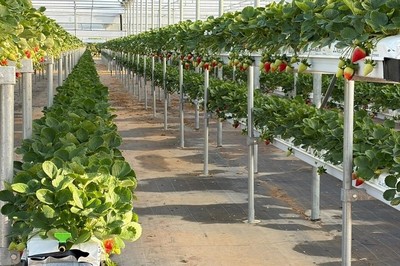
The greenhouse systems are tailored to meet the technical and agronomic requirements of individual farms. A commonly adopted design features double rows of eaves with carefully spaced gutters, allowing growers to maximize cultivation space and improve operational efficiency.
One recently completed three-hectare project in Basilicata demonstrates the potential of the technology. By using a multi-level vertical cultivation system, the project nearly doubled the effective growing area compared with conventional open-field farming, making it possible to transplant around one million berry seedlings within the same footprint.
According to the company, double-gutter systems can increase planting density by up to 15 percent compared with traditional cultivation methods. Higher planting densities, combined with controlled growing conditions, also facilitate integrated pest management practices, reducing reliance on synthetic pesticides and supporting more environmentally sustainable production.
Combimetal Carrera attributes much of its success to innovative engineering and installation techniques. Rather than transporting fully assembled components, the company manufactures key structural elements directly at customer sites. This approach reduces transportation costs, shortens installation time and enables the production of continuous steel profiles measuring nearly 28 metres in length, minimizing structural joints and improving overall durability.
Company representatives say the technology addresses one of agriculture’s growing challenges—improving working conditions while maintaining profitability.
The elevated cultivation systems reduce the physical demands placed on workers during planting, maintenance and harvesting operations. They also create cleaner production environments, simplify crop management, improve fruit uniformity and ripening, and enable more precise control of irrigation, plant nutrition and pest management.
These operational improvements have translated into measurable productivity gains. In several recently completed commercial installations, growers were able to achieve an additional harvest early in the production season, increasing overall output and improving returns on investment.
The greenhouse systems also support research and varietal development through partnerships with leading industry organizations. Combimetal Carrera collaborates with commercial producer Nicofruit and breeding specialist Nova Siri Genetics to evaluate and propagate new berry varieties under controlled conditions before they are introduced to international markets.
Industry experts note that protected soilless cultivation is becoming an increasingly important component of modern horticulture as growers face mounting pressures from climate change, labour shortages and the need to produce high-quality fruit with fewer natural resources.
The expansion of greenhouse infrastructure highlights Italy’s commitment to modernizing its horticultural sector through precision agriculture, innovative engineering and sustainable production practices, positioning the country as a leading adopter of advanced berry cultivation technologies in Europe.