
Liaquat Ali
Islamabad: Pakistan this week called on the United Nations Security Council to strengthen international action against the exploitation and weaponisation of natural resources, warning that weak governance, illegal extraction and unilateral actions over shared resources continue to fuel conflicts and threaten global peace and security.
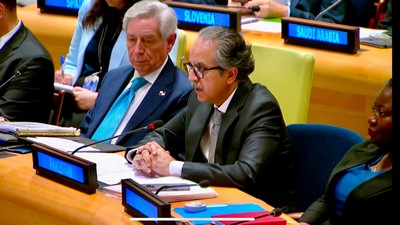
Addressing the Security Council’s High-Level Open Debate on “Natural Resource Governance: The Foundation of Peace, Security and Prosperity”, Pakistan’s Permanent Representative to the United Nations, Ambassador Asim Iftikhar Ahmad, said natural resources should serve as drivers of sustainable development and shared prosperity rather than becoming instruments of coercion, instability and geopolitical rivalry.
He noted that throughout history, natural resources have shaped civilizations, economic development and technological progress, adding that their strategic importance has grown further as the world transitions toward clean energy, artificial intelligence, advanced manufacturing and digital technologies.
“The global competition for critical minerals is becoming one of the defining geopolitical realities of our time,” he observed, stressing that this growing demand must not come at the expense of international law, national sovereignty or equitable development.
The Pakistani envoy argued that while natural resources have the potential to transform economies, weak governance, illicit extraction, unequal distribution of benefits and external interference continue to fuel humanitarian crises and armed conflicts, particularly in developing countries.
Referring to Africa, Ambassador Ahmad reaffirmed Pakistan’s longstanding support for African nations in safeguarding sovereign control over their natural wealth. He cited the Democratic Republic of the Congo (DRC) as a prominent example where the illicit exploitation and trafficking of mineral resources have financed armed groups and deprived local populations of the benefits of their country’s abundant natural wealth.
He emphasized the need for stronger traceability mechanisms, responsible supply chains and enhanced regional cooperation to disrupt conflict financing and ensure that natural resources contribute to sustainable development rather than violence.
The ambassador also called for resource-rich developing countries to become equal partners in global value chains instead of remaining exporters of raw materials. He urged greater emphasis on responsible investment, local processing industries, technology transfer, skills development and equitable revenue-sharing arrangements.
“Sustainable peace cannot be achieved where immense natural wealth coexists with persistent poverty and underdevelopment,” he said, warning that such disparities create conditions conducive to instability and conflict.
Highlighting the importance of international law, Ambassador Ahmad said the governance of natural resources must remain firmly anchored in the United Nations Charter and the principle of permanent sovereignty over natural wealth as enshrined in UN General Assembly Resolution 1803. International cooperation, he said, should strengthen national capacities while fully respecting national ownership and policy priorities.
Turning to transboundary resources, the Pakistani envoy stressed that cooperative and lawful management of shared water resources is indispensable for preventing disputes, promoting peaceful relations among neighbouring states and ensuring regional stability.
In this context, he sharply criticized India over its decision to place the Indus Waters Treaty in abeyance, describing the move as unlawful and contrary to both the treaty’s provisions and established principles of international law.
Ambassador Ahmad said Pakistan categorically rejects India’s unilateral action, arguing that it directly threatens the livelihoods and well-being of more than 240 million Pakistanis who depend on the Indus river system for agriculture, drinking water and economic activity.
He maintained that the Indus Waters Treaty remains valid, legally binding and fully in force, referring to the August 2025 Award of the Court of Arbitration, which reaffirmed the treaty’s continued applicability.
“No state should be permitted to weaponize shared water resources as an instrument of coercion or political pressure,” he said, adding that such actions become even more concerning in the context of the unresolved Jammu and Kashmir dispute, which he described as a longstanding flashpoint in South Asia with serious implications for international peace and security.
Calling for a more proactive role by the Security Council, Ambassador Ahmad said the Council bears a special responsibility whenever the exploitation or weaponisation of natural resources threatens international peace. He urged the Council to fully utilize available mechanisms, including preventive diplomacy, peaceful dispute resolution, sanctions regimes and monitoring frameworks, to address emerging threats linked to natural resource conflicts.
The Pakistani envoy emphasized that natural resources should unite nations through cooperation rather than divide them through competition and conflict. He reaffirmed Pakistan’s commitment to working with the international community to ensure that the world’s natural wealth is managed responsibly, contributes to sustainable development and serves the collective interests of humanity while strengthening peace, stability and equitable global prosperity.