

Abida Shaheen
Ankara: Canadian Prime Minister Mark Carney thus week announced a sweeping package of defence investments, industrial partnerships and security initiatives at the 2026 North Atlantic Treaty Organization Summit, reaffirming Canada’s commitment to strengthening the Alliance and increasing defence spending to 5% of GDP by 2035.
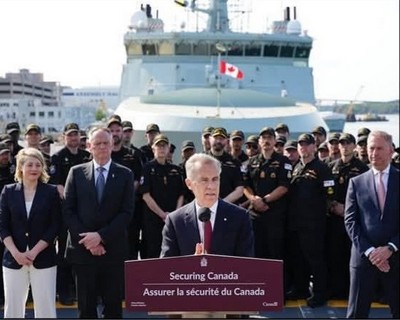
Concluding his participation at the summit in Ankara, Carney said Canada was undertaking a generational transformation of its defence posture through historic investments, military modernization and expanded cooperation with NATO allies in response to an increasingly complex global security environment.
The Canadian prime minister said the country was accelerating investments in a new submarine fleet, the world’s second-largest fleet of icebreakers, advanced fighter aircraft, long-range missile systems and cyber defence capabilities, while placing particular emphasis on strengthening Arctic security and protecting North America.
As part of the new initiatives, Canada reached an agreement in principle with Telesat to provide sovereign military satellite communications across the Arctic through the Telesat Lightspeed network, a project expected to generate multi-billion-dollar investment in Canada’s defence sector.
Carney also announced an approximately $800 million contract with Kongsberg Defence and Aerospace to procure Joint Strike Missiles for integration into the Royal Canadian Air Force’s future fighter aircraft fleet.
In support of Canada’s domestic defence industry, the government unveiled an updated procurement strategy for its Light Utility Vehicle programme, limiting the tender process to two Canadian defence suppliers to deliver between 1,600 and 2,100 military vehicles and up to 500 utility trailers for the Canadian Armed Forces.
To strengthen NATO’s technological edge, Carney confirmed that Canada would begin technical negotiations to join the NATO Innovation Sub-Fund, aimed at supporting emerging defence technologies while providing Canadian innovators with greater access to investment, strategic partnerships and international markets.
Canada will also host the 2027 NATO Industry Forum, bringing together governments and industry leaders to advance defence innovation, industrial cooperation and supply chain resilience across the Alliance.
Highlighting efforts to deepen economic ties with allies, Carney announced the launch of negotiations with Germany on a comprehensive Canada-Germany Strategic Partnership Agreement, covering defence, security, technology, investment, energy, supply chains, critical minerals and space cooperation.
He also confirmed the start of negotiations with Türkiye on a comprehensive bilateral free trade agreement, noting that two-way trade between the two countries reached $4.3 billion in 2025.
On collective defence, Carney announced the extension of Operation REASSURANCE, Canada’s largest overseas military mission, until 2031, with plans to increase Canada’s permanently deployed personnel to as many as 2,600 troops to reinforce NATO’s eastern flank.
He further confirmed that Canada would join Latvia and Denmark as the third Framework Nation of Multinational Division North, expanding its leadership role in strengthening NATO’s deterrence and defence posture in Eastern Europe.
The prime minister also highlighted international support for the proposed Defence, Security and Resilience Bank (DSRB), a Canada-led multilateral financial institution designed to mobilise private investment for defence, security and resilience projects across allied countries. Canada will host the institution’s headquarters, which is expected to provide long-term financing for defence industries, emerging technologies and supply chain resilience.
Reaffirming Canada’s support for Ukraine, Carney announced that part of the country’s previously pledged approximately $2 billion military assistance package would fund $475 million worth of ammunition, nearly $400 million for 35 Canadian-manufactured armoured combat support vehicles, and $50 million for information technology and engineering equipment.
Canadian officials said the country has committed more than $25.5 billion in overall assistance to Ukraine since 2022, including over $8.5 billion in military support.
During the summit, Carney also held bilateral meetings with NATO Secretary General Mark Rutte and leaders from Denmark, Finland, Germany, Hungary, Iceland, Latvia, North Macedonia, the Netherlands, Poland, Portugal, Romania, Sweden, Türkiye, the United Kingdom and Ukraine to discuss strengthening allied capabilities, continued support for Ukraine and enhancing maritime security, including efforts to ensure safe navigation through the Strait of Hormuz.
Canada said the initiatives announced at the summit reinforce its commitment to collective defence, strengthen NATO’s industrial and military capabilities and position the country to play a larger role in safeguarding transatlantic security and Arctic stability.